Top Things to Do in Graz: Must-See Attractions & Experiences
I have visited Graz several times, and it is one of the cities I find myself recommending most often to visitors looking for somewhere beyond Vienna and Salzburg.
Graz, Austria’s second-largest city and the capital of Styria, is one of the country’s most underrated destinations.
If you are looking for the best things to do in Graz, you will find a city that blends historic charm with bold modern design.
Most of Graz’s sights are within the compact city centre, making it easy to get around on foot and perfect for wandering and exploring.
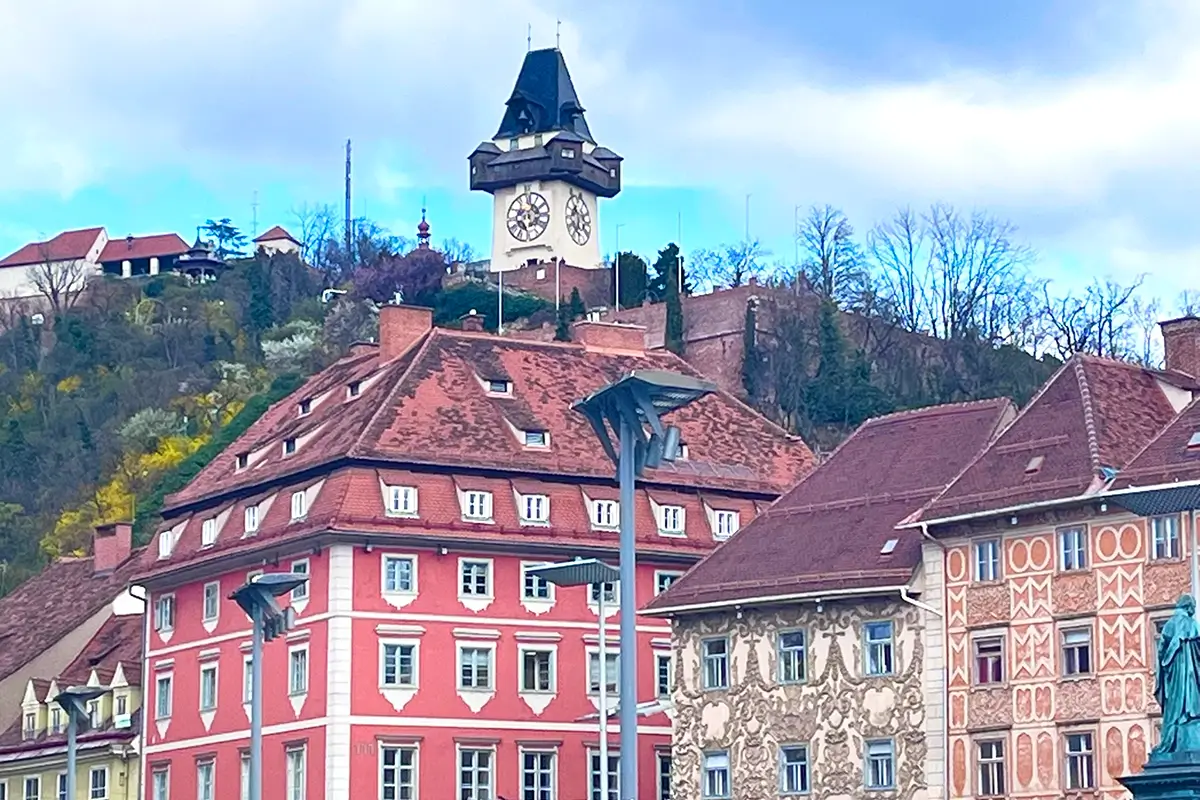
With its UNESCO-listed Old Town, striking contemporary architecture, and a strong food and wine culture, Graz offers a different pace to Vienna or Salzburg.
It is relaxed, creative, and easy to explore on foot, making it ideal for slow travel.
From historic landmarks and scenic viewpoints to local markets, museums, and cafés, there are plenty of things to do in Graz, Austria.
Whether you are interested in culture, architecture, or simply wandering through beautiful streets, Graz rewards curiosity and unplanned exploration.
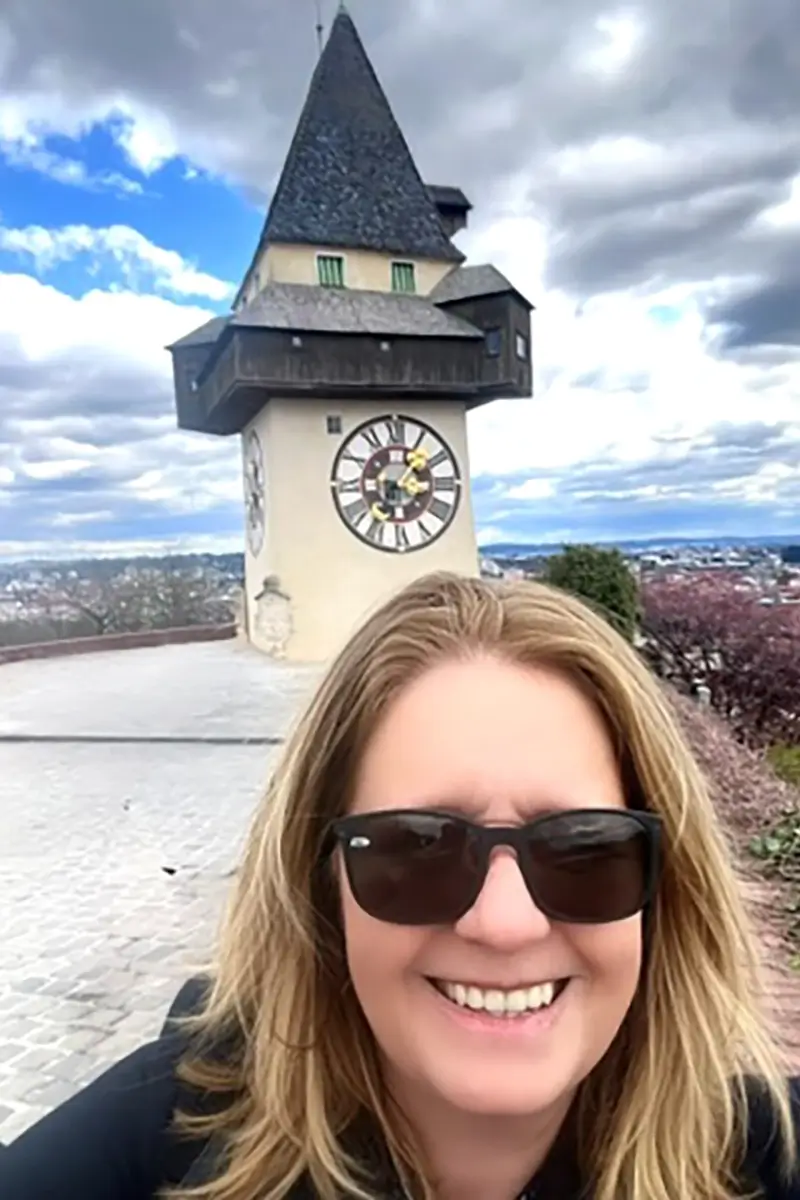
Hi, I’m Tammy, the founder of Austria Wanderlust.
I live in Austria and spend much of my time exploring the country, sharing practical advice and local insights to help you plan your trip with confidence.
Graz is one of my favourite cities to return to. I have visited multiple times, and each trip has been a little different, whether focusing on the main sights, exploring museums, or simply enjoying the cafés and food scene. This guide is based on my own experiences and highlights the places I genuinely recommend after spending time in the city.
Join our Newsletter
Copyright: Unless otherwise stated, all images on this website are copyright Wanderlustria e.U.
Disclosure: Some links on this page are affiliate links. If you make a purchase through them, I may earn a small commission at no extra cost to you. This helps support Wanderlustria and allows me to continue creating free Austria travel resources and guides. Read Disclaimer and Terms & Conditions
Join the Austria Travel Planning Facebook Group
Follow us on:
🌟Top tip: To plan my visit to Graz, my first stop was the Graz Tourist Information office next to the Landhaus, where I picked up the free city map and walking guide. Although this wasn’t my first visit, I still found it invaluable and continue to think it is one of the best planning tools for exploring the city. The guide includes three self-guided walking routes that connect many of Graz’s main attractions while leading you through streets and courtyards I might otherwise have walked straight past.
If it is your first visit to Graz, I wouldn’t try to see everything in one day. Graz is one of those cities where slowing down is part of the experience. My advice is to choose a handful of attractions, leave time for lunch at a local restaurant, and enjoy wandering the streets between sights rather than rushing from one landmark to the next.
Here is my Bucket list of what to See in Graz
What to See in Graz
Schlossberg & Uhrturm (Clock Tower)
The Schlossberg, the „city mountain“, is in the heart of Graz and the perfect starting point for any visit, offering panoramic views over the Old Town’s iconic, red-tiled rooftops.
You can reach the summit via a scenic climb, the glass elevator (2.50€ single ride), or the historic funicular (part of the city’s public transport network).
I opted for the elevator, and it was very straightforward, with tickets available from machines at the base.
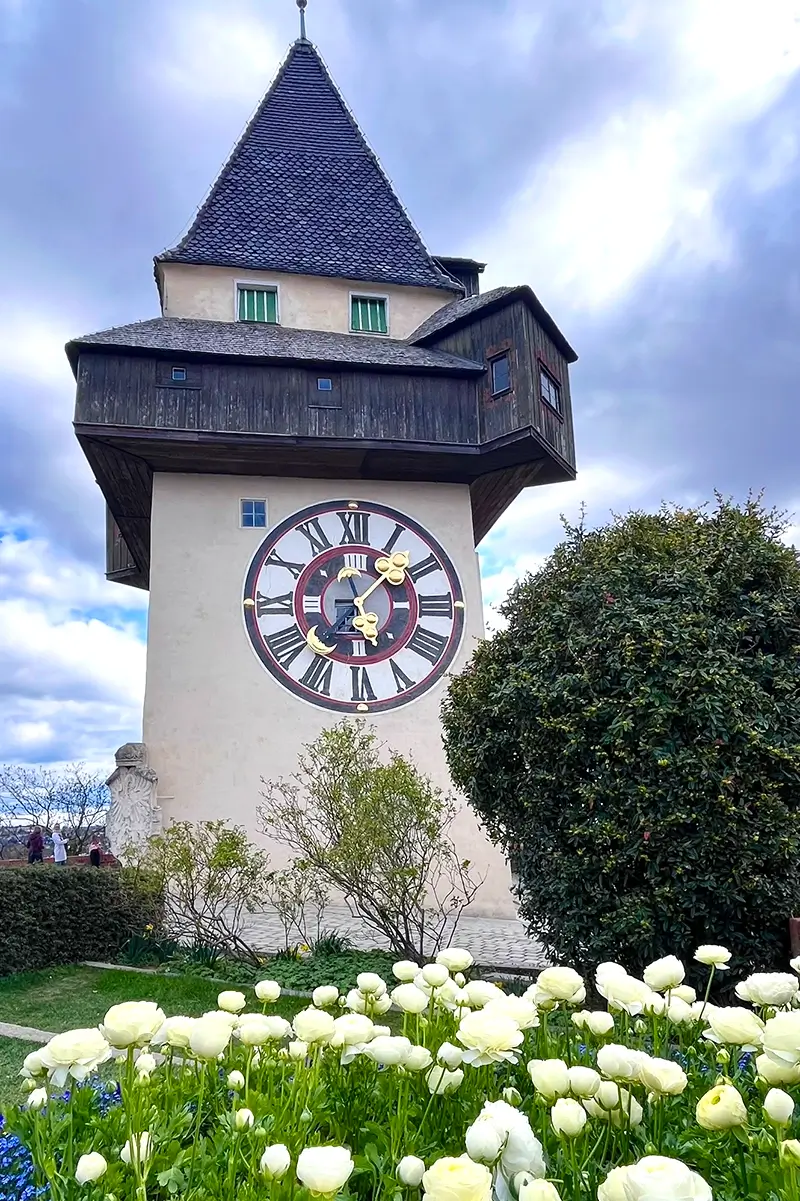
Once at the top, you are greeted by the Uhrturm (Clock Tower), the city’s most iconic landmark and it is one of those sights that instantly anchors you in the city.
The 28-metre-tall landmark (92 feet) was originally a 13th-century defensive tower that. has been keeping time since 1712
Beyond the tower, I really enjoyed simply wandering the plateau.
There are peaceful walking paths, viewpoints such as the Chinese Pavilion, and the historic Turkish Well, all spread out in a way that makes it feel more like a park than a monument.
For a deeper look into its history, the Graz Museum Schlossberg is housed within the historic Stallbastei (Stable Bastion).
It traces the hill’s evolution from a 10th-century fortress, through its role during the Napoleonic Wars, to the public space it is today.
I descended via the Schlossbergsteige (stairs), passing the Habersteingarten, a Mediterranean-style terrace garden, making my way back down.
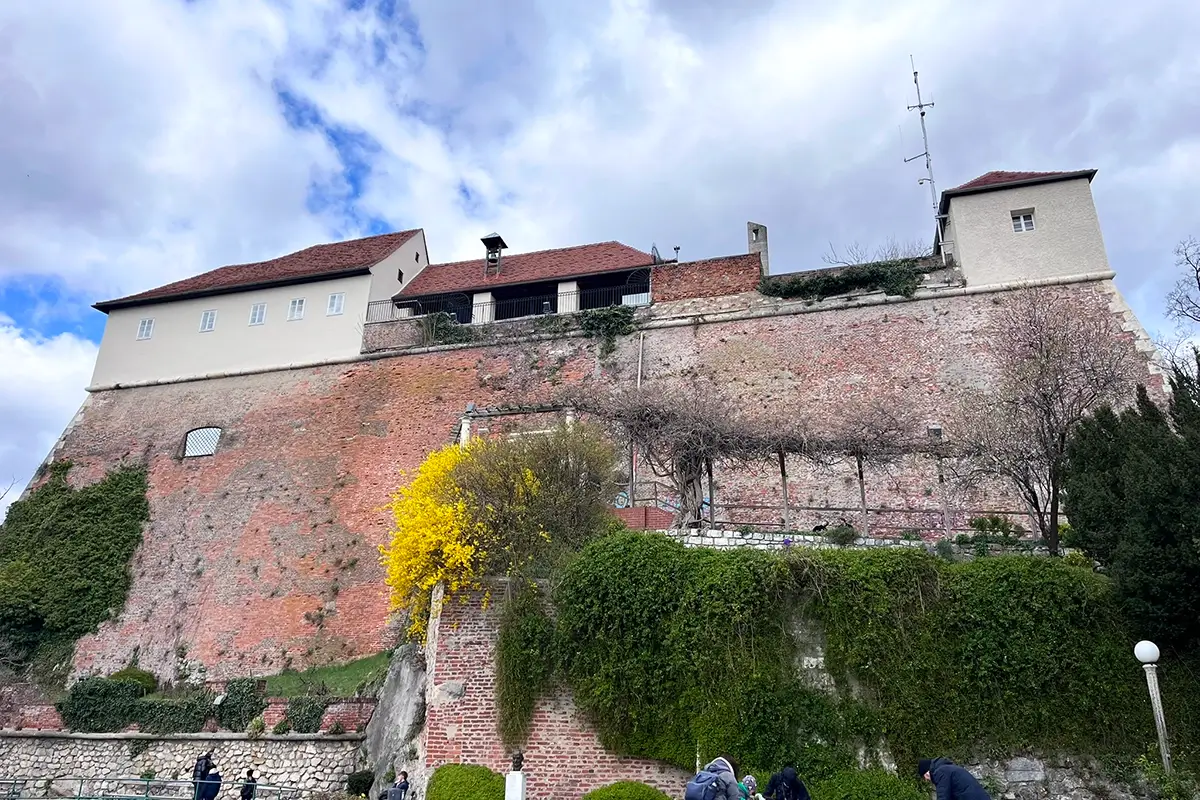
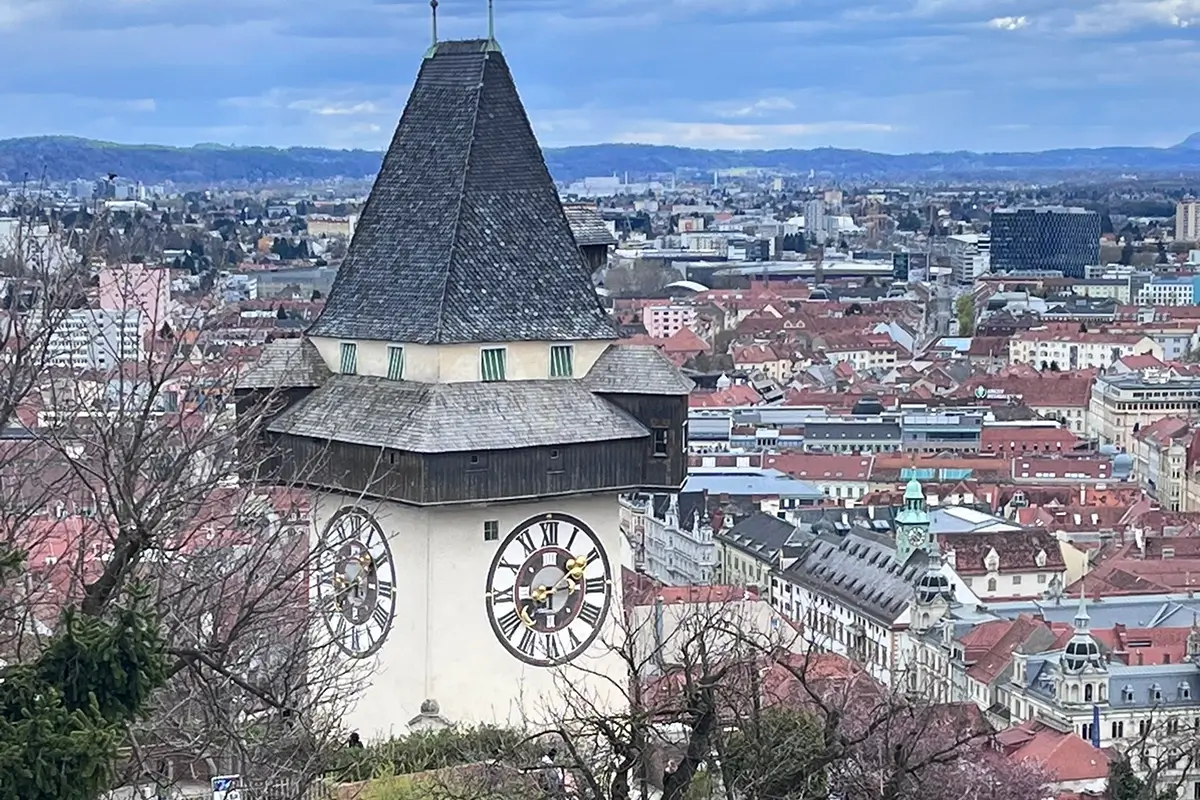
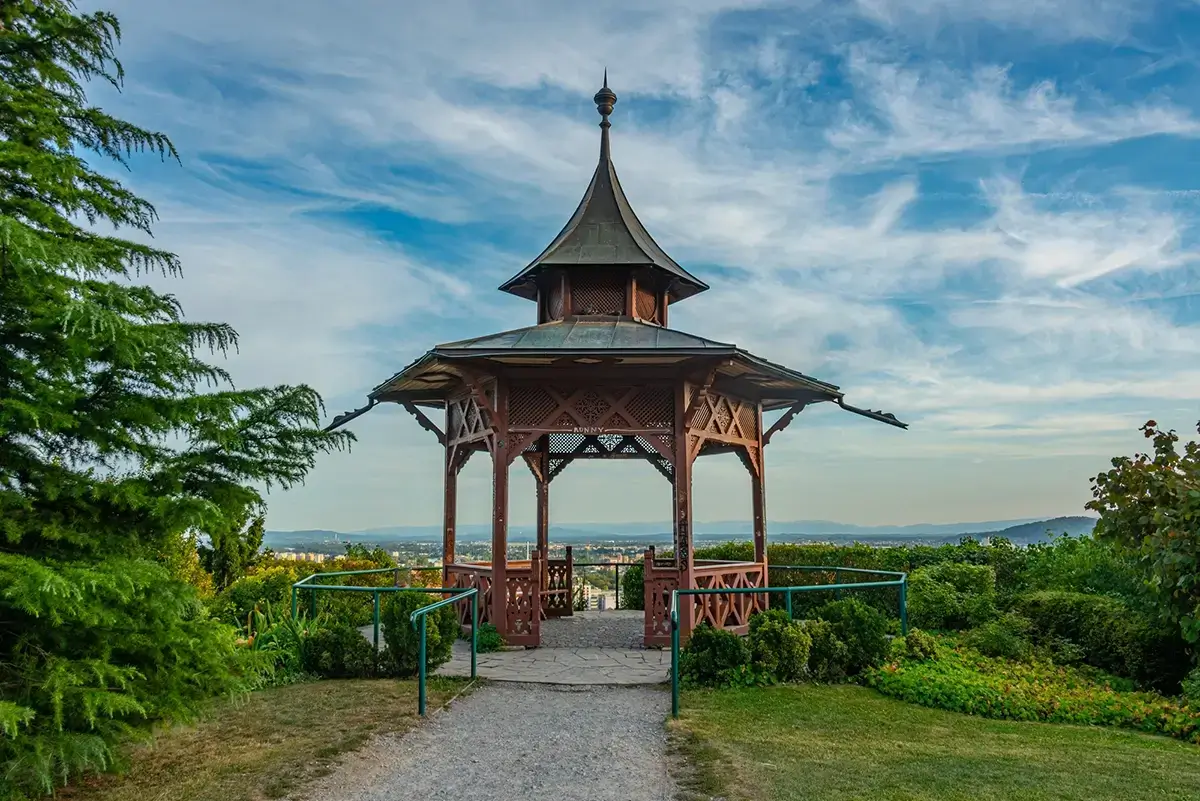
I did make it up to the Schlossberg at night, and it was well worth it.
The views over Graz were especially atmospheric after dark, with the illuminated Uhrturm and Old Town rooftops giving the whole city a completely different feel.
The Altstadt (Old Town): What to See in Graz’s Historic Centre
Wandering through the Altstadt (Old Town) was one of my favourite parts of exploring Graz.
It is a UNESCO World Heritage Site and one of the best-preserved city centres in Central Europe, but what stood out most for me was how easy it is just to slow down and wander.
Rather than following a set route, I found the best way to experience Graz was simply getting a little lost among the cobbled streets, quiet courtyards, and the mix of Gothic, Renaissance, and Baroque façades that appear around every corner.
I spent a lot of time walking along Herrengasse, the city’s grand main street, which is lined with historic palaces, elegant buildings, and plenty of cafés and shops to dip in and out of as you go.
Sporgasse was another highlight for me.
This gentle uphill street is one of the oldest in Graz and has a more local, lived-in feel, with small boutiques, cafés, and plenty of character.
It is a really scenic route through the Old Town and a great place to slow down and explore without rushing.
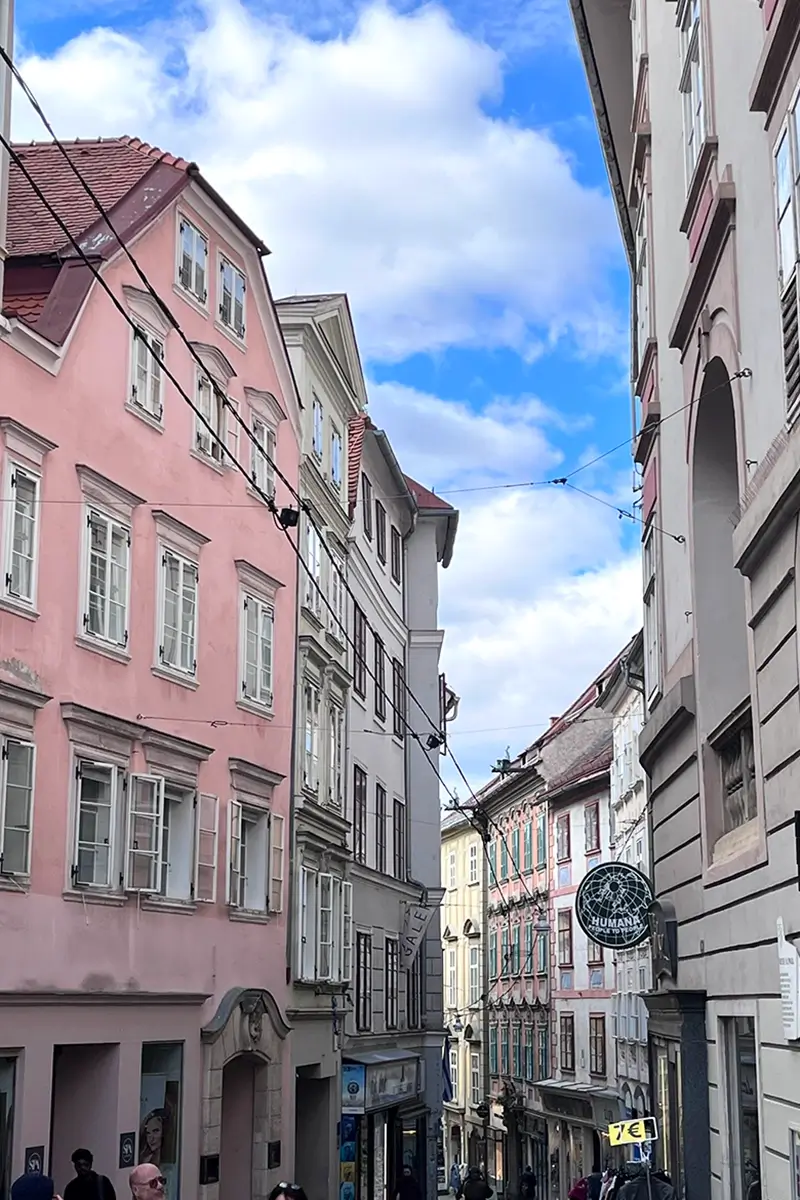
View of Sporgasse shopping street in Graz, lined with historic buildings, cafés, and local shops.
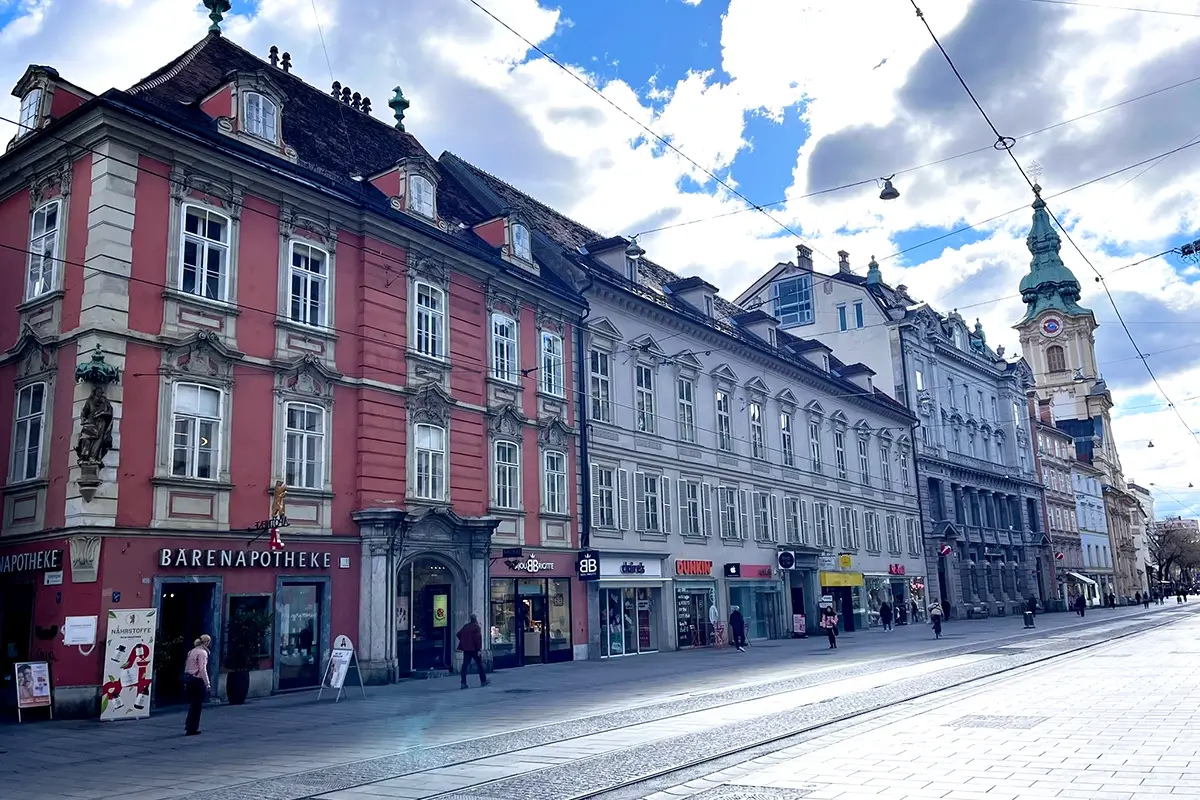
Herrengasse
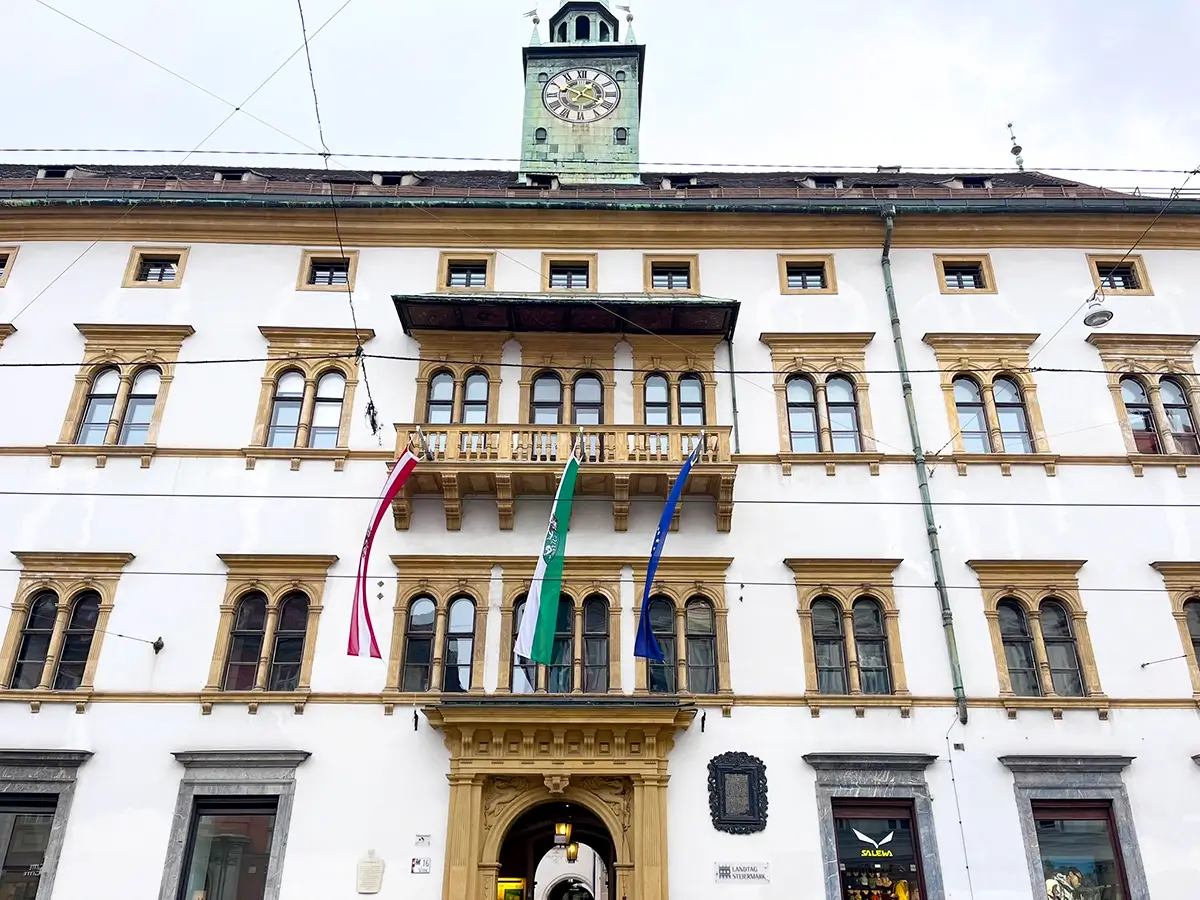
Graz Landeshaus
Hauptplatz (Main Square)
The Hauptplatz is the vibrant heart of Graz and one of the key things to see in Graz, surrounded by beautifully painted historic façades and the 19th-century Rathaus (City Hall).
In the centre of the square stands the Archduke Johann fountain, dating back to 1878.
During my visit, the square was set up with an Easter market, which added a really lively seasonal atmosphere. It’s also the main venue for Christmas markets and traditional folk festivals throughout the year, so it always feels like something is happening here.
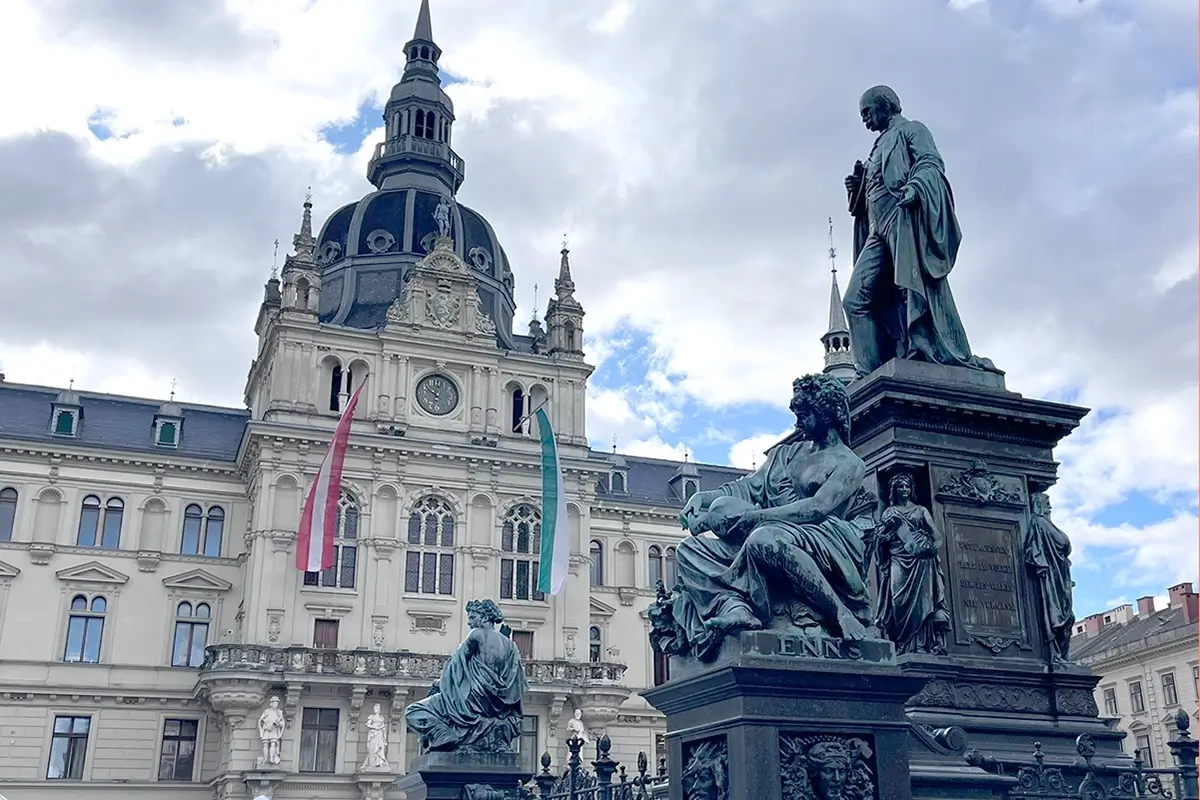
I loved the colour of the surrounding buildings, painted in soft shades of pastel pink, ochre, and blue, with intricate architectural details that really show off Graz’s historic character.
At the corner of Sporgasse, you’ll find the striking Luegghaus, with its ornate stucco façade, now home to Swarovski.
Just off the square on Herrengasse 3 is the Painted House (Gemaltes Haus), also known as Herzoghaus. Its entire façade is covered in elaborate frescoes painted in 1742 by Johann Mayer, depicting scenes from Greco-Roman mythology. It is one of those details you might miss at first glance, but it really stands out once you notice it.
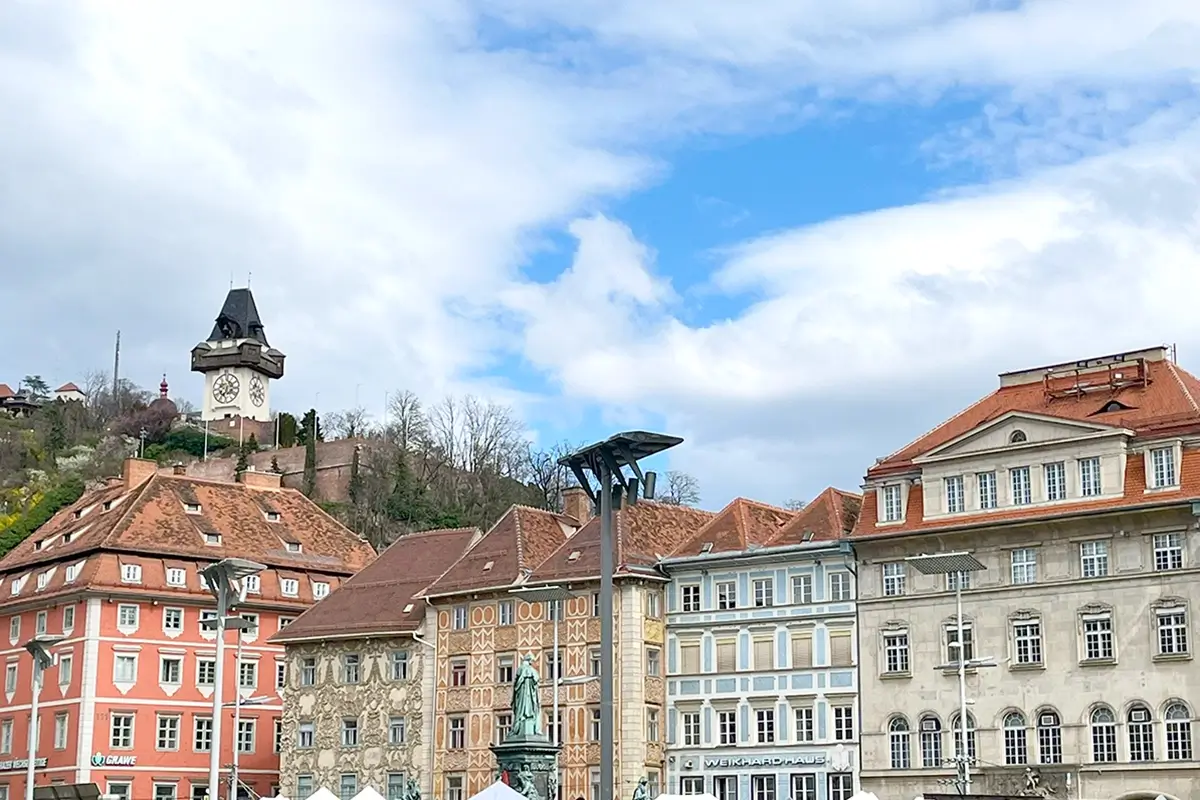
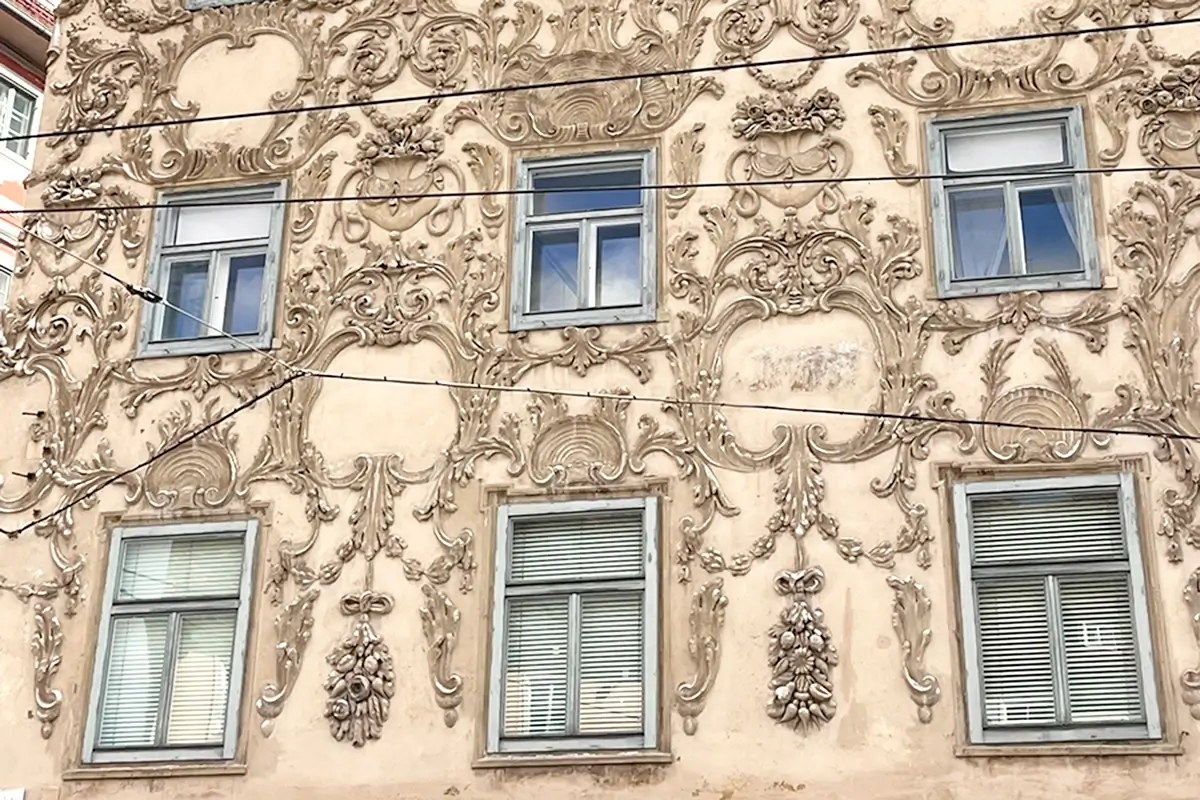
Luegghaus
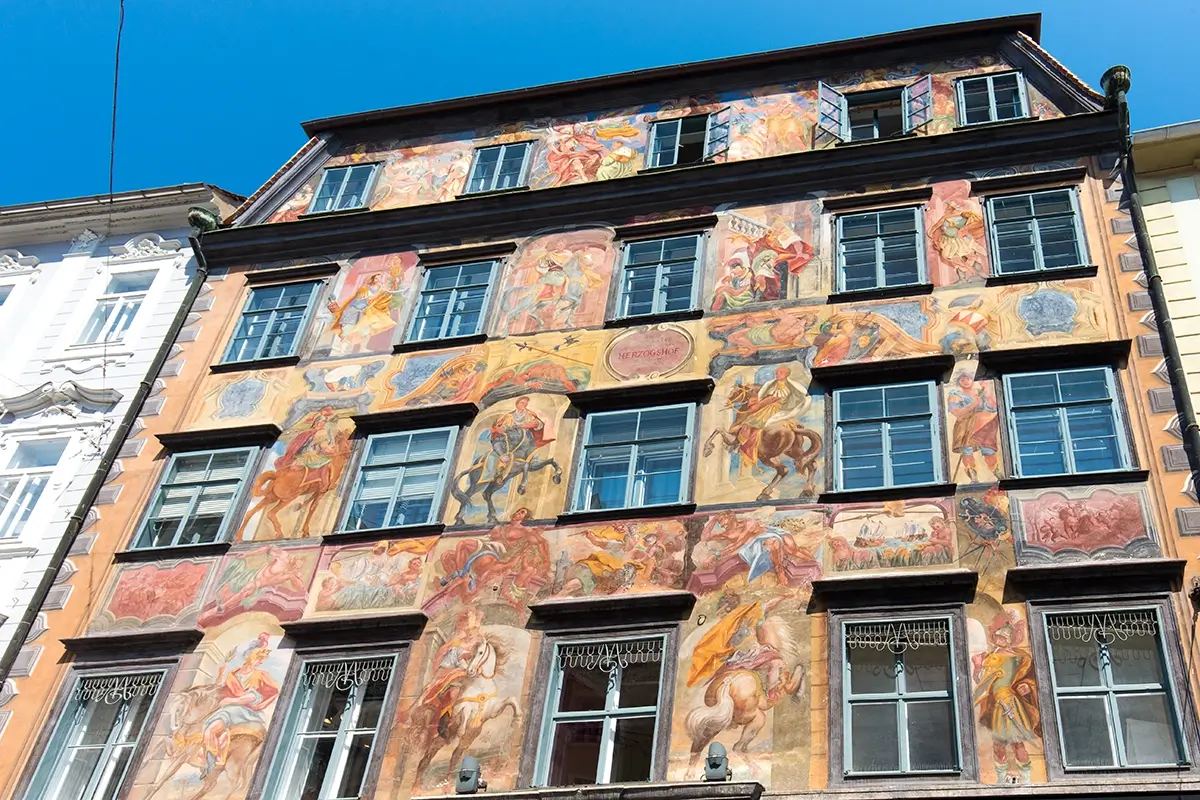
Gemaltes Haus – Image © Graz Tourismus – Harry Schiffer
Explore the Courtyards of Graz
One of the things I loved most about Graz was discovering its hidden courtyards.
From the street, many of them are easy to miss, tucked behind simple doorways, but stepping inside often reveals some of the most beautiful and unexpected spaces in the city.
The most impressive is the Landhaus courtyard (Styrian Parliament). Walking in, it really opens up, with three levels of arcaded walkways, elegant Tuscan columns, and a striking bronze fountain at the centre. It’s easy to see why it’s considered one of the top landmarks in Graz.
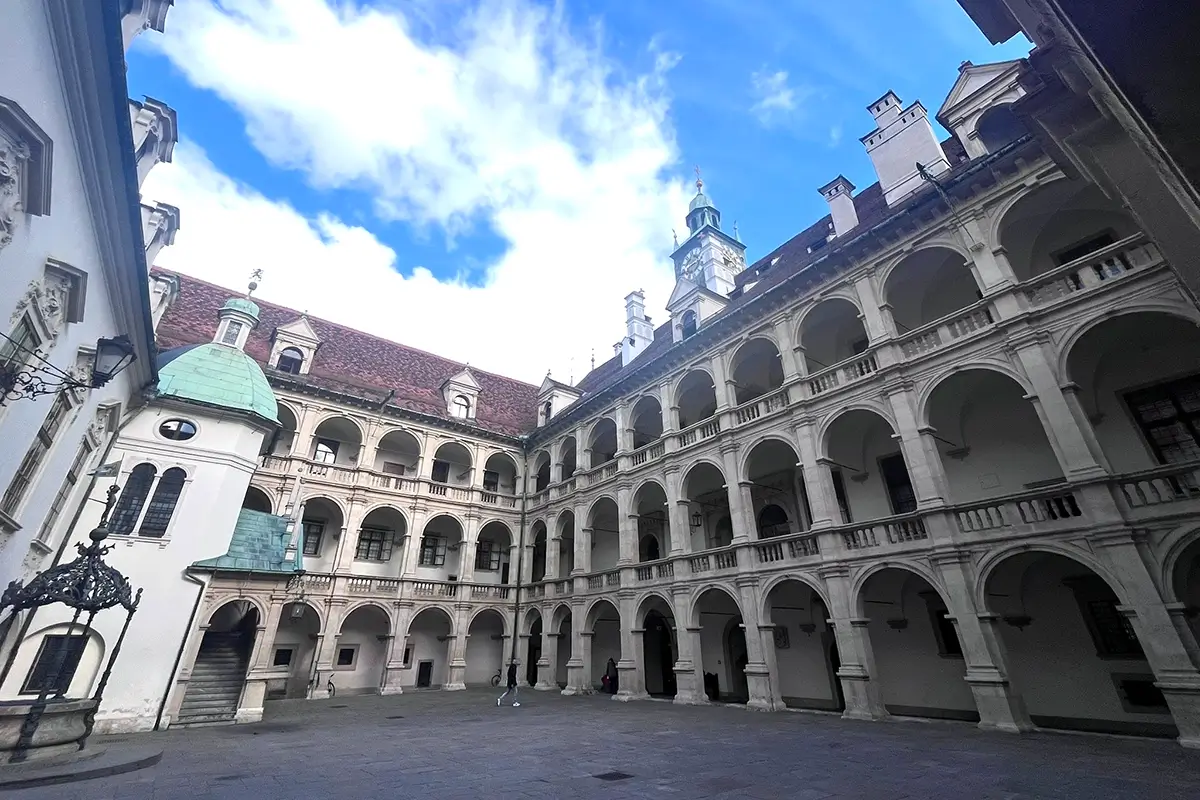
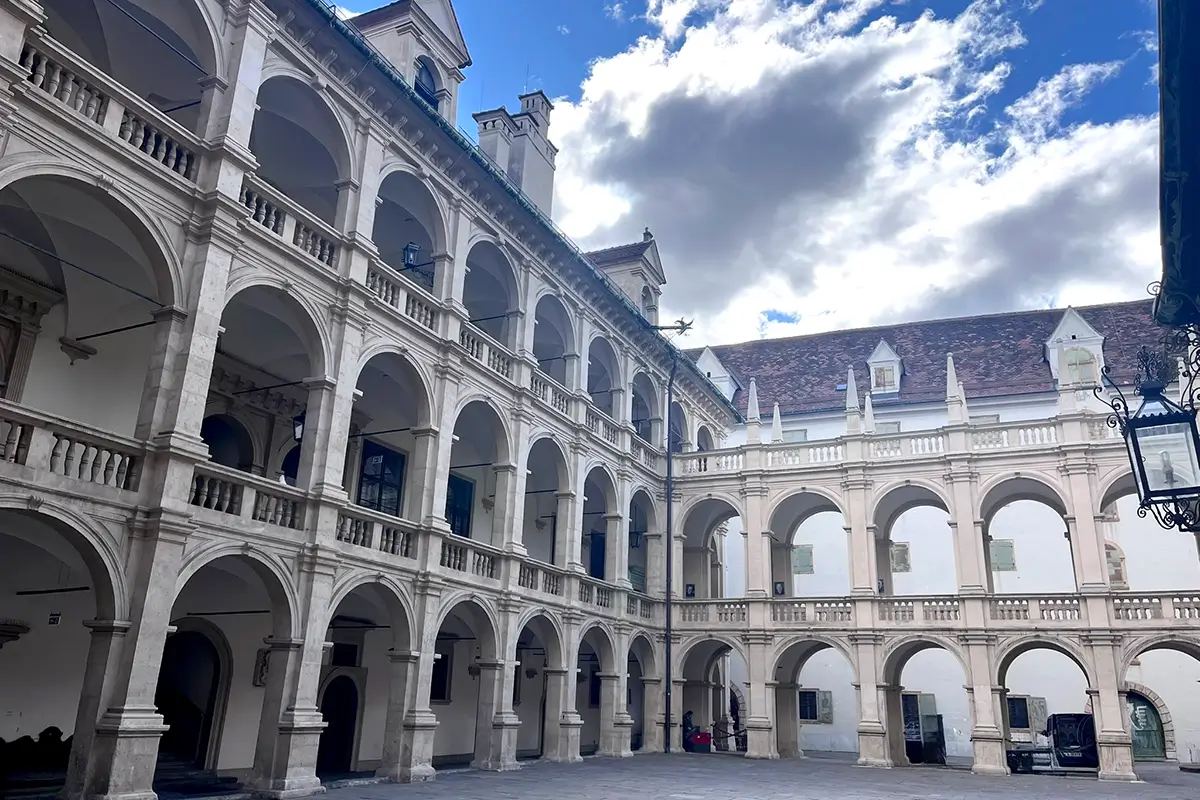
Just across the street at Herrengasse 9, the Generalihof feels much quieter. It has a similar Renaissance style but with a more peaceful atmosphere, and I found it a nice contrast to the busier spots nearby.
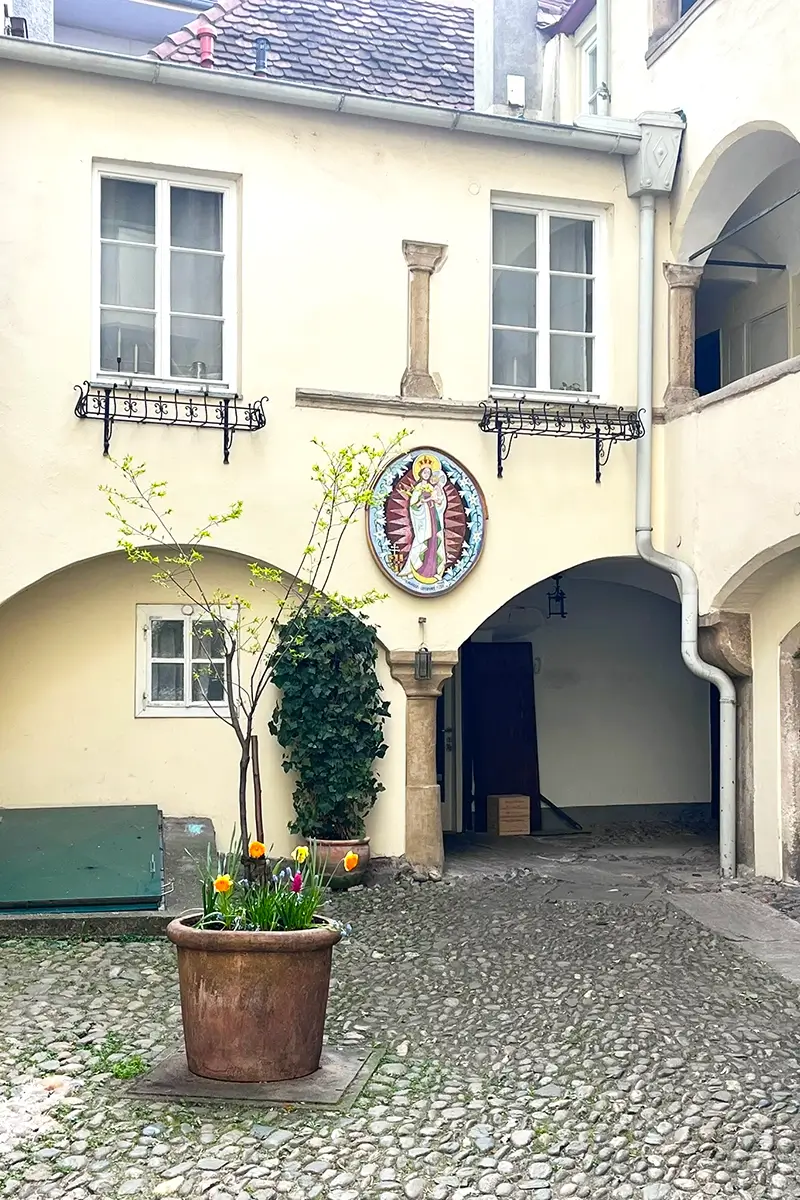
One of the more unexpected finds was the Hof des Deutschen Ritterordens (Court of the German Knights’ Order) located at Sporgasse 22.
The first thing I noticed was the distinctive “Murnockerl” paving, made from rounded river stones shaped by the Mur over centuries. Looking up, you can see the mix of architectural styles, with late Gothic arcades below and Renaissance columns above.
There are plenty of smaller courtyards scattered throughout the Old Town, and I quickly got into the habit of stepping inside whenever I saw an open doorway.
Some are simple, others more elaborate, but they all offer a quieter glimpse into Graz away from the main streets.
Visit the Styrian Armoury (Landeszeughaus)
Even if you are not into military history, the Styrian Armoury is one of the most fascinating things to see in Graz.
I found it a real highlight and was genuinely surprised by just how impressive it is.
It felt like stepping into a European “Terracotta Army”, with rows of armour and weapons dating from the 15th to 19th centuries.
The armoury has been preserved in its original 17th-century state, with wide, worn wooden floorboards and weapons still displayed on traditional wooden racks, just as they were when Styria was defending its borders against Hungarian rebels and the Ottoman Empire.
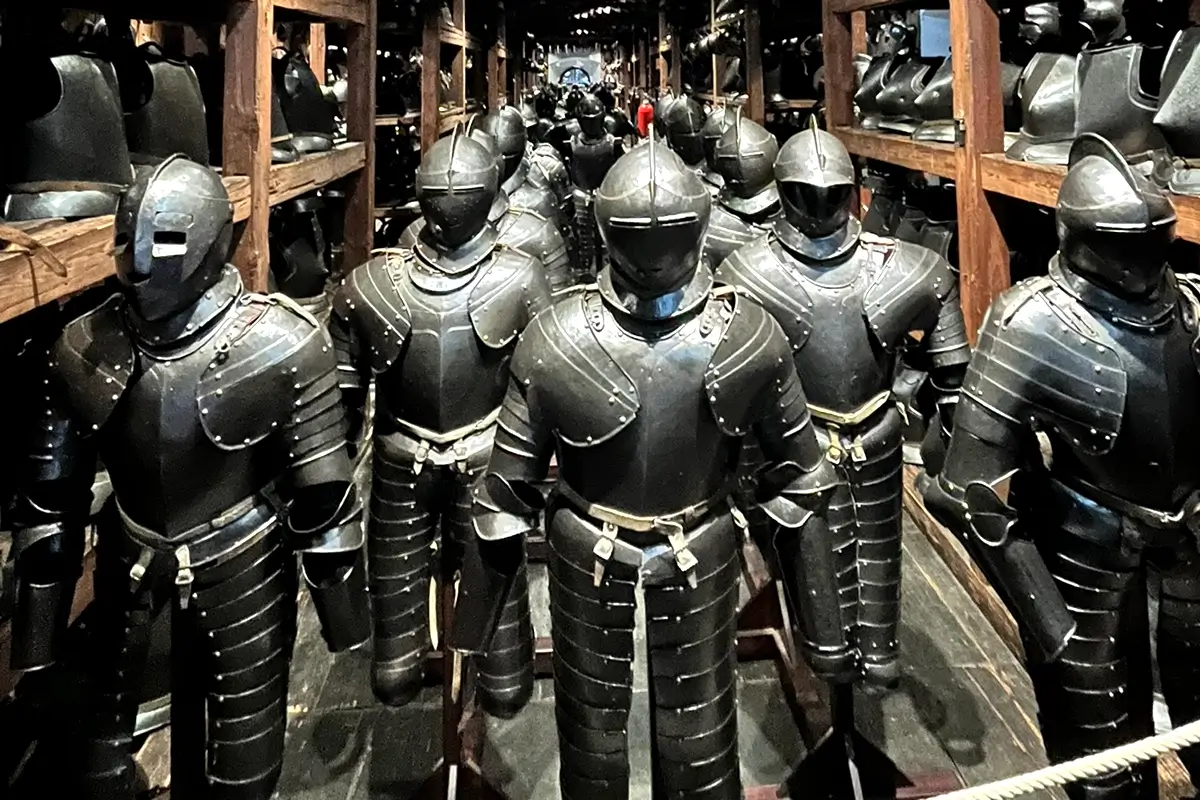
It is one of the world’s largest historic armouries, housing over 30,000 pieces, including full suits of armour, helmets, shields, and firearms.
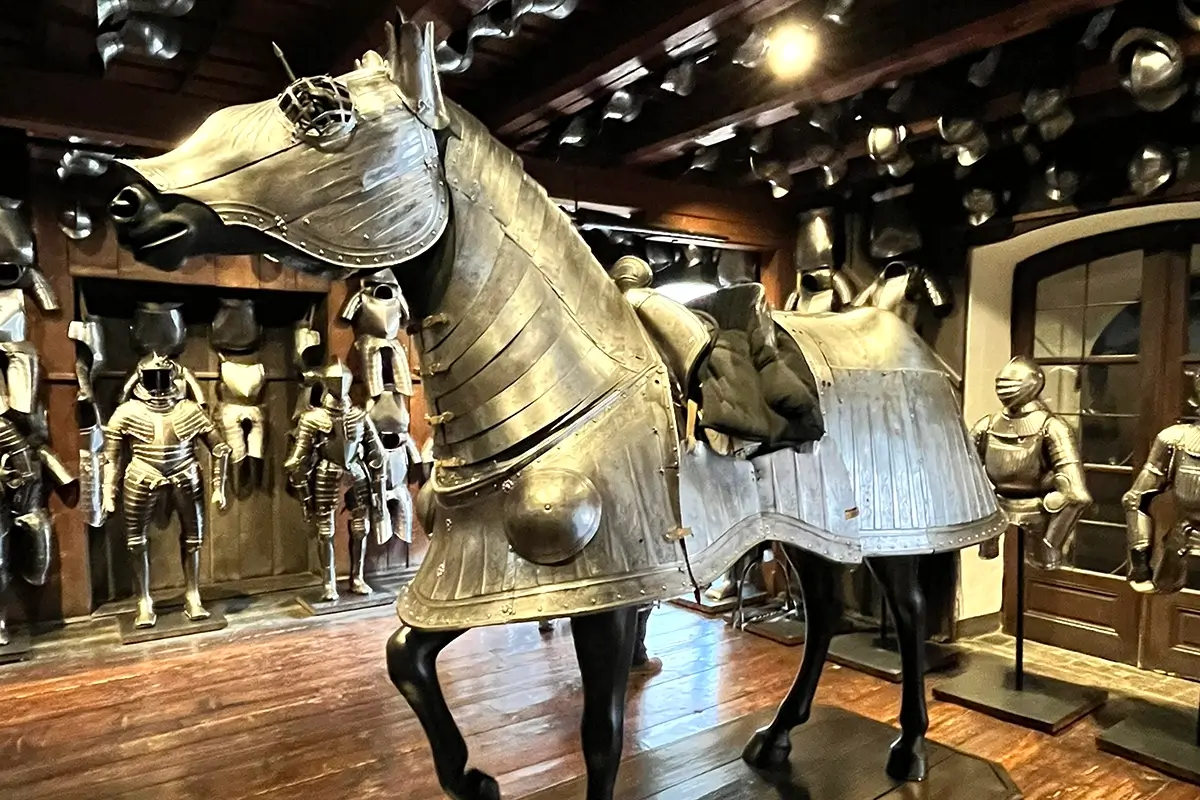
One of the highlights is the rare horse armour, one of only seven completely preserved horse armours in the world.
Where to Stay in Graz
Graz is compact and easy to get around, so you have a few great options depending on your style of travel.
♦ Where I recently stayed – Gästehaus Moßhammer Great location, it is close to Stadtpark, it’s an easy walk into the Old Town, with a local, student feel and plenty of cafés, restaurants, and good transport links nearby.
♦ Family-Friendly / With Pool: Parkhotel Graz It has an indoor pool and spa, and is located next to Stadtpark. ~15 min walk to the City centre and connected by tram and bus.
♦ Mid-Range Augarten Art Hotel A stylish hotel with an indoor pool, spa, and gym. Located just outside the city centre, but still only a short tram ride or walk into the centre.
♦ Boutique / in City Centre Schlossberghotel A lovely boutique option right in the Old Town, close to the Uhrturm. It has a small rooftop pool.
Glocknerspielplatz
Walk through the Glockenspielplatz passageway at Herrengasse 7 to reach this lively square tucked just off the main street.
The Glockenspielhaus sits on the north side of the square, in what was Gottfried Maurer’s wine shop, now home to the Glockenspiel café.
Three times a day at 11 am, 3 pm, and 6 pm, two arched windows open in the building’s gable and a wooden couple dressed in traditional Styrian Trachten appear, twirling to the sound of 24 bells.
At the end of the performance, a golden rooster flaps its wings and crows three times.
The Glockenspiel was created by Gottfried Maurer as a clever way to attract customers into his wine shop.
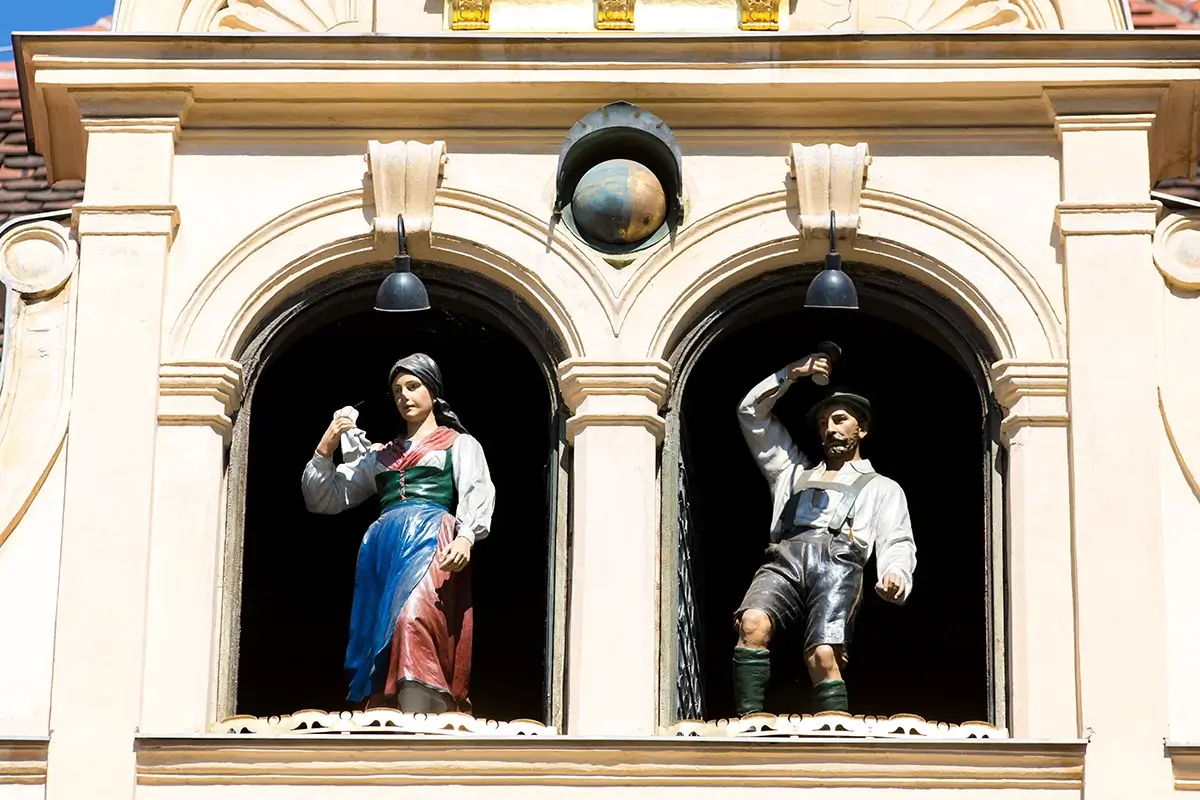
Glockenspiel © Graz Tourismus – Harry Schiffer
Today, the square is a lively meeting spot and part of what locals call the “Bermuda Triangle of Graz”, where it is easy to lose track of time between the bars, cafés, and restaurants.
I found it surprisingly easy to sit here longer than planned, soaking up the atmosphere, and it’s somewhere I’d happily return to enjoy traditional Styrian dishes at one of the local restaurants or taverns.
Graz Cathedral and Mausoleum
Tucked into the Old Town, Graz Cathedral is a striking mix of Gothic and Baroque architecture that feels quite understated from the outside, especially compared to other European cathedrals.
The Grazer Dom (Cathedral) was built between 1438 and 1464 under Emperor Frederick III.
One detail I made sure to look for was the Landplagenbild (“God’s Plagues” fresco) on the south exterior wall. Painted in 1485, it depicts three disasters that struck Graz: a locust invasion, war with the Turks, and the Black Death.
What I found particularly interesting about this site is that the Cathedral sits directly beside the Mausoleum, commissioned by Emperor Ferdinand II in 1614 but not completed until 1714.
Inside the Mausoleum, you’ll find the ornate red marble sarcophagus of Ferdinand’s mother. Ferdinand himself is buried much more simply, in a plain wall niche marked only by a modest tablet, which feels surprisingly understated given the grandeur around it.
Together, they almost feel like two completely different worlds side by side.
The Cathedral is a vast Gothic hall with a relatively simple exterior, while the Mausoleum is a bold Baroque structure with a turquoise dome and a distinctly Italianate feel.
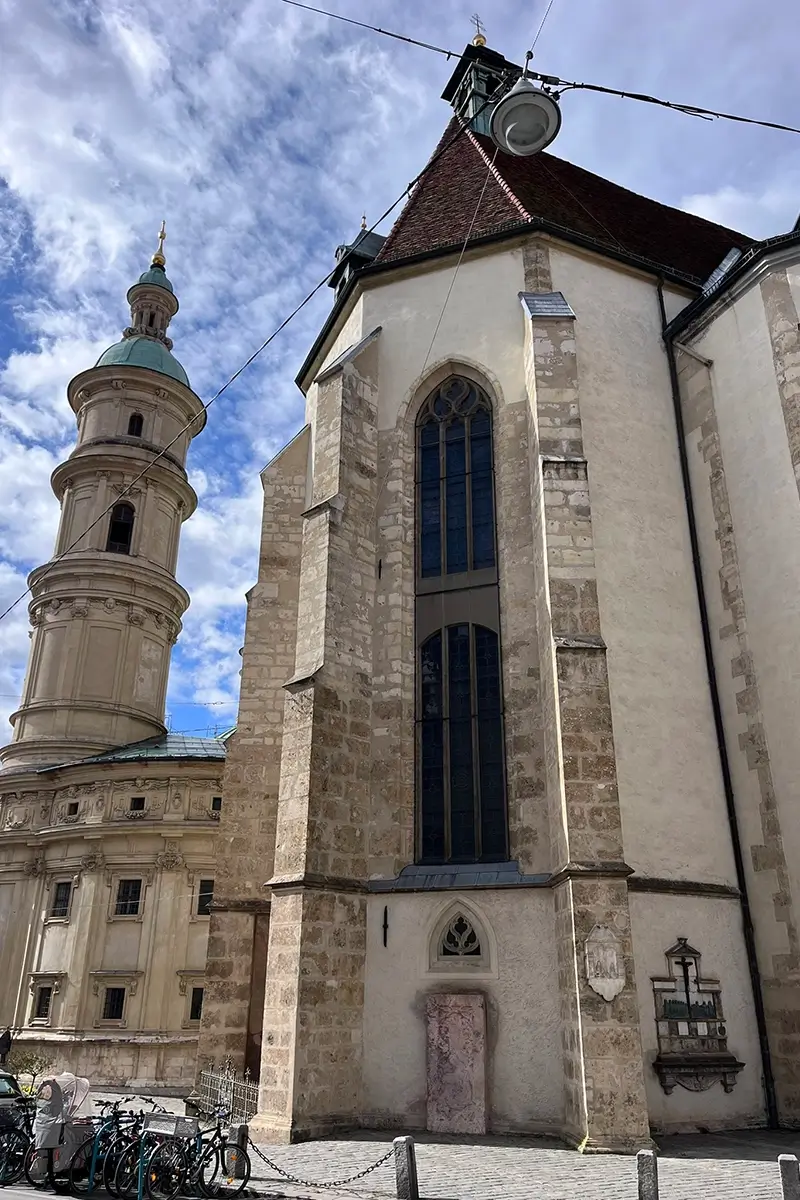
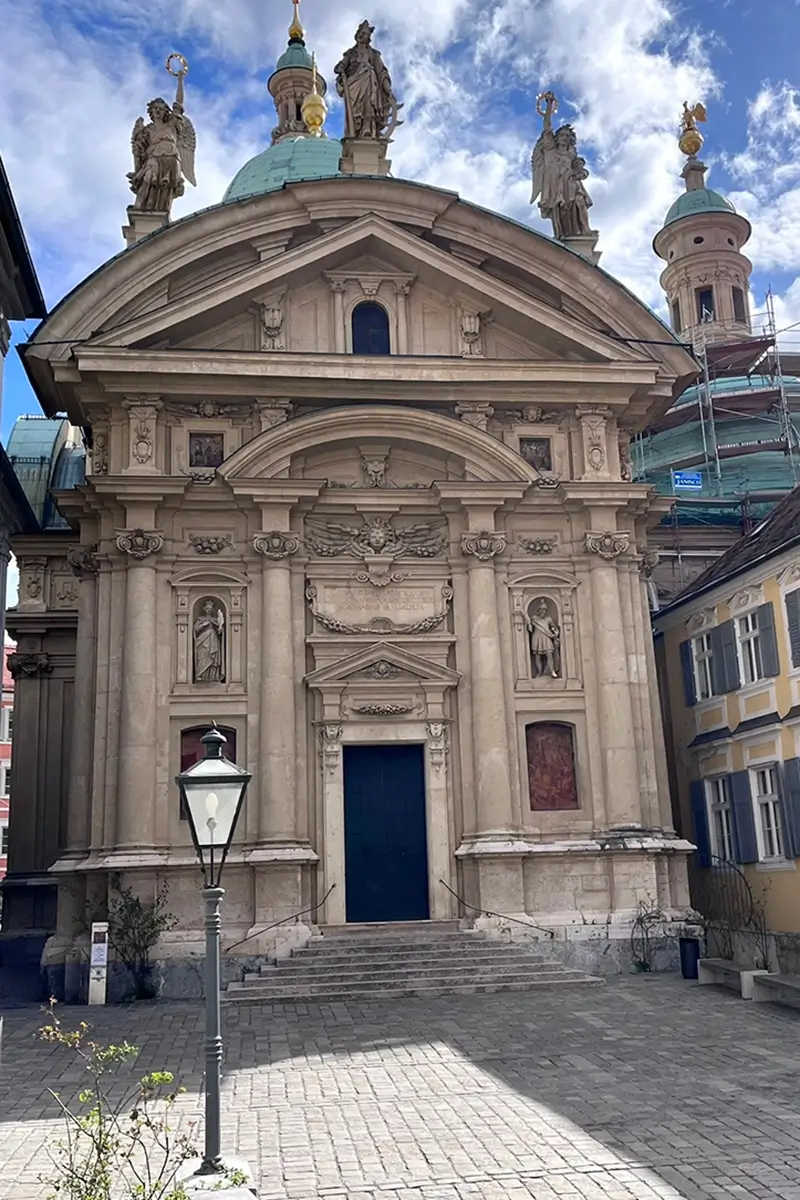
Left image: A view of the Graz ‘City Crown’: On the right stands the Gothic Grazer Dom (Cathedral), while the left is dominated by the Mausoleum of Emperor Ferdinand II, featuring its iconic turquoise oval dome and bell tower.
Right image: The facade of the Mausoleum
Burg & the Double Spiral Staircase
Across from the Cathedral at the end of Hofgasse, you’ll find the Burg (Castle), which has served as the official seat of the Styrian government for centuries.
Originally begun in 1438 under Duke Frederick V (later Holy Roman Emperor Frederick III), it was built, expanded, and partially redesigned between the 15th and 20th centuries, resulting in a mix of Gothic, Renaissance, and Biedermeier styles.
The complex is currently undergoing a major multi-year renovation project expected to continue until 2028, so access is limited in parts.
While I was slightly disappointed not to see more of the Burg itself, my main focus was the Double Spiral Staircase, which felt like a must-visit.
As someone with a background in science and developmental biology, the idea of a double helix in architectural form was impossible to resist.
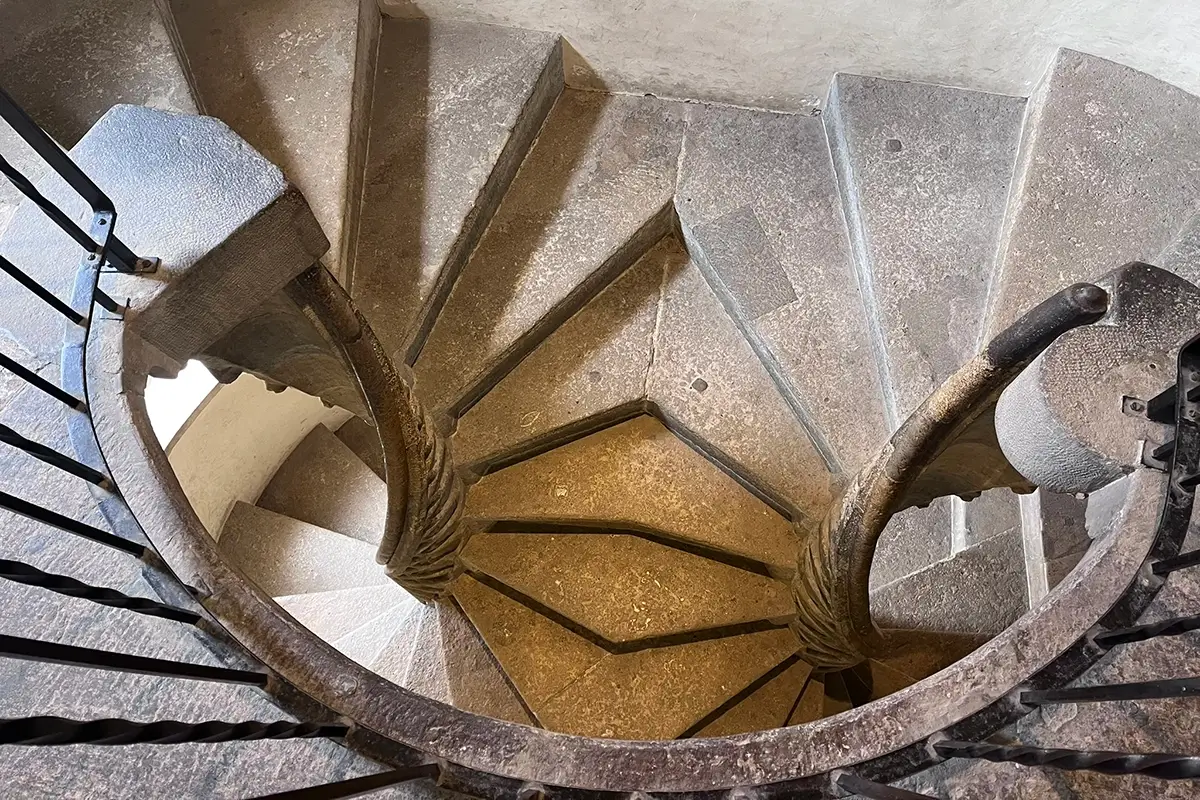
Crossing the courtyard, you reach the Doppelwendeltreppe (Double Spiral Staircase), built in 1499 for Emperor Maximilian I.
It is a masterpiece of late Gothic stonework.
Also known as the “Treppe der Versöhnung” (Staircase of Reconciliation), the design features two separate staircases that split and reunite on each level, symbolising people meeting again after going separate paths.
At first glance from below, it appears to be a single solid stone pillar, but as you climb, the structure gradually reveals itself as two intertwined spirals circling a central axis. It’s one of those architectural details that is far more impressive in person than any photo can really capture.
Franziskanerkirche (Franciscan Church)
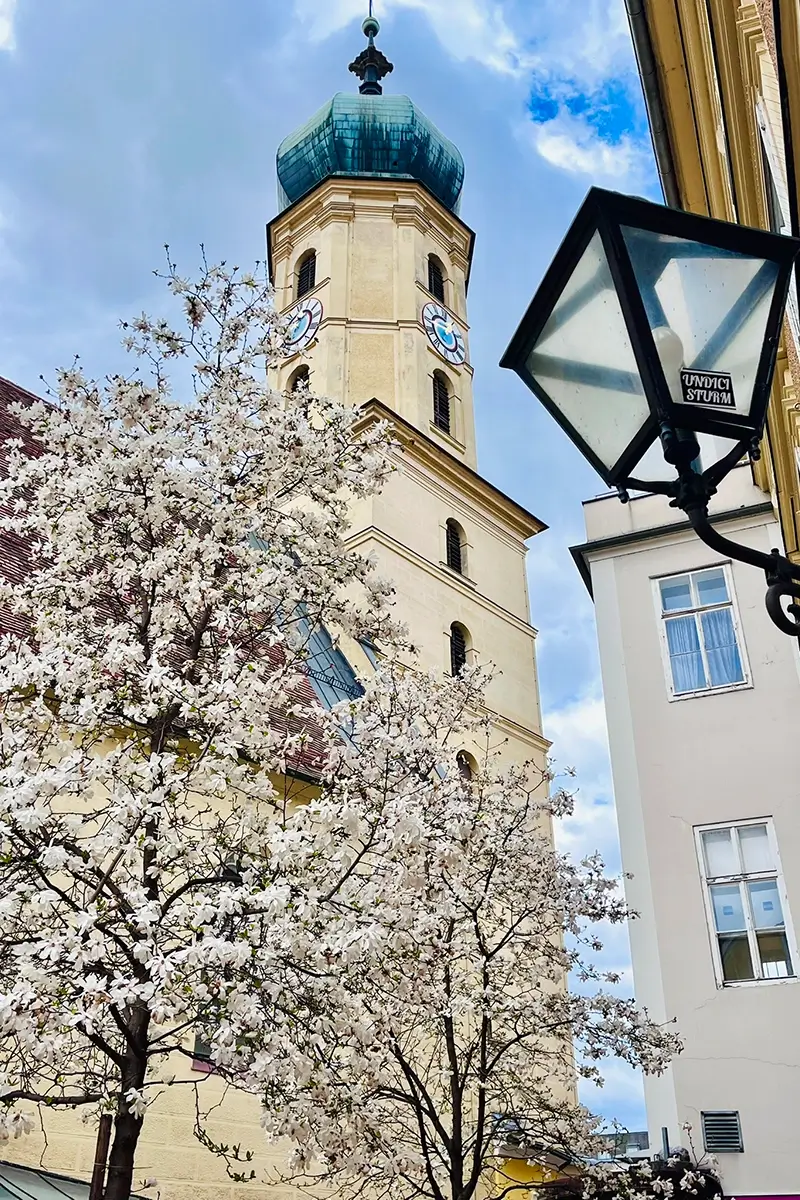
The Franziskanerkirche is the oldest monastery in Graz, founded around 1239, and one of the most atmospheric places in the Old Town.
It is recognisable by its high tower topped with a Baroque onion dome.
After being damaged during World War II, the chancel was restored in a striking contemporary style. Inside, the vibrant stained-glass windows are especially beautiful, filling the nave with shifting colour and light as you move through the space.
Next to the church is the Franziskanerkloster (monastery and cloister), accessed through a gate beside the main entrance. Stepping through, you find the original Gothic cloisters, which feel quiet and almost hidden from the city outside. The monastery garden and the small Jakobikapelle (Jacobean Chapel) add to the sense of calm in this part of Graz.
The surrounding area is known as the Franziskanerviertel, also historically referred to as the “Kälberne Viertel” (veal quarter), where traditional butcher shops once stood.
Today, it has a much more relaxed feel, with boutique shops, cafés, wine bars, and restaurants, and a slightly Mediterranean atmosphere, especially given how close it is to the Mur River.
I found myself naturally drawn back to this area more than once during my time in Graz.
Kunsthaus Graz
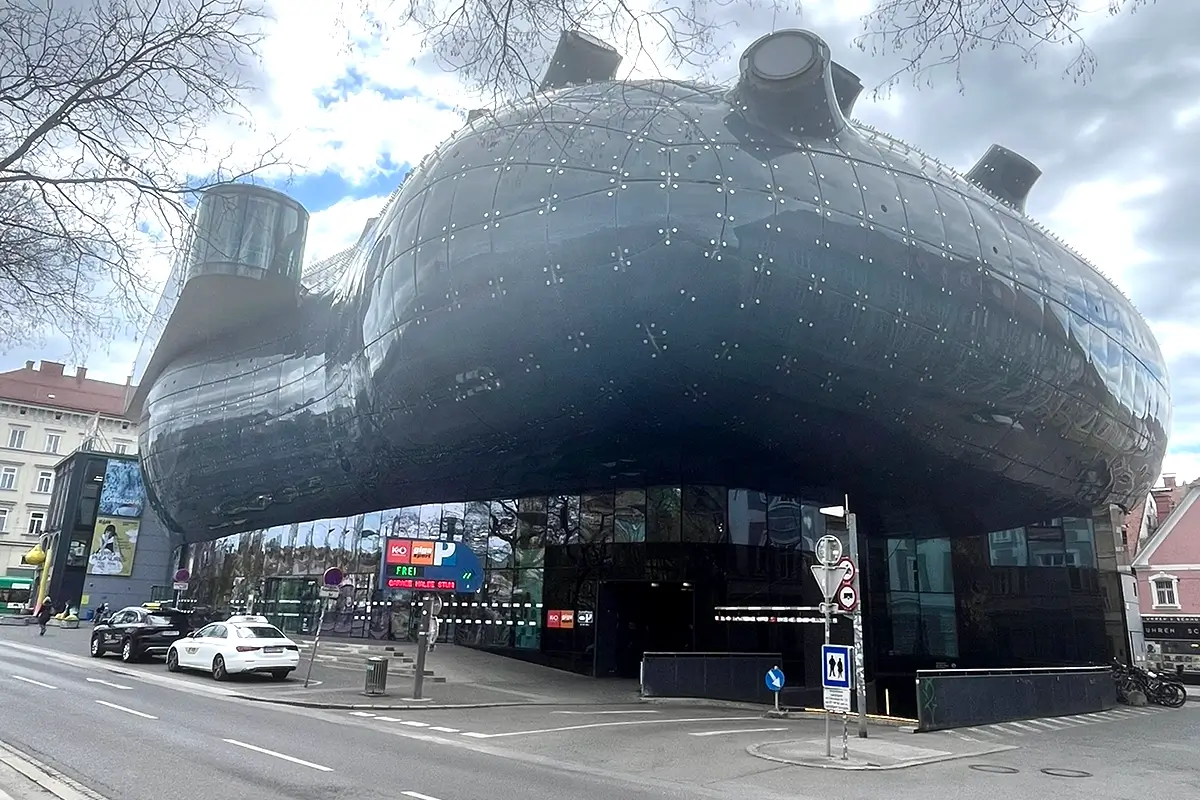
Nicknamed the “Friendly Alien,” the Kunsthaus Graz is one of the city’s most striking modern landmarks and a key example of contemporary things to see in Graz.
Built in 2003, its biomorphic “blob” architecture is formed from blue acrylic panels that deliberately contrast with the surrounding historic Old Town and its red-tiled rooftops.
For me, it felt like a bold visual statement of how Graz blends the old and the new in such an unexpected way.
Inside, the museum hosts rotating contemporary exhibitions, including the Camera Austria photography programme, alongside a small gift shop and café.
When I visited Kunsthaus Graz, what stood out most was how dynamic and thought-provoking the exhibitions are — from explorations of social media’s impact to deeper connections between art and everyday life, alongside showcases of well-known artists.
The museum focuses on contemporary art, often exploring themes linked to modern life, technology and culture.
It is one of those places that feels completely different from the rest of the city, yet still very much part of Graz’s identity.
Murinsel (Mur Island): A Contemporary Graz Landmark
The Murinsel is one of Graz’s most unique and modern landmarks — a floating platform on the Mur River that functions as part bridge, part café, and part art installation.
Designed by New York artist Vito Acconci for the 2003 European Capital of Culture, the floating shell was intended to be temporary, but it has since become a permanent feature of the city.
It is connected to both sides of the river by footbridges, effectively linking the historic Altstadt (Old Town) with the more creative Lend district, and it works as both a pedestrian crossing and a public space.
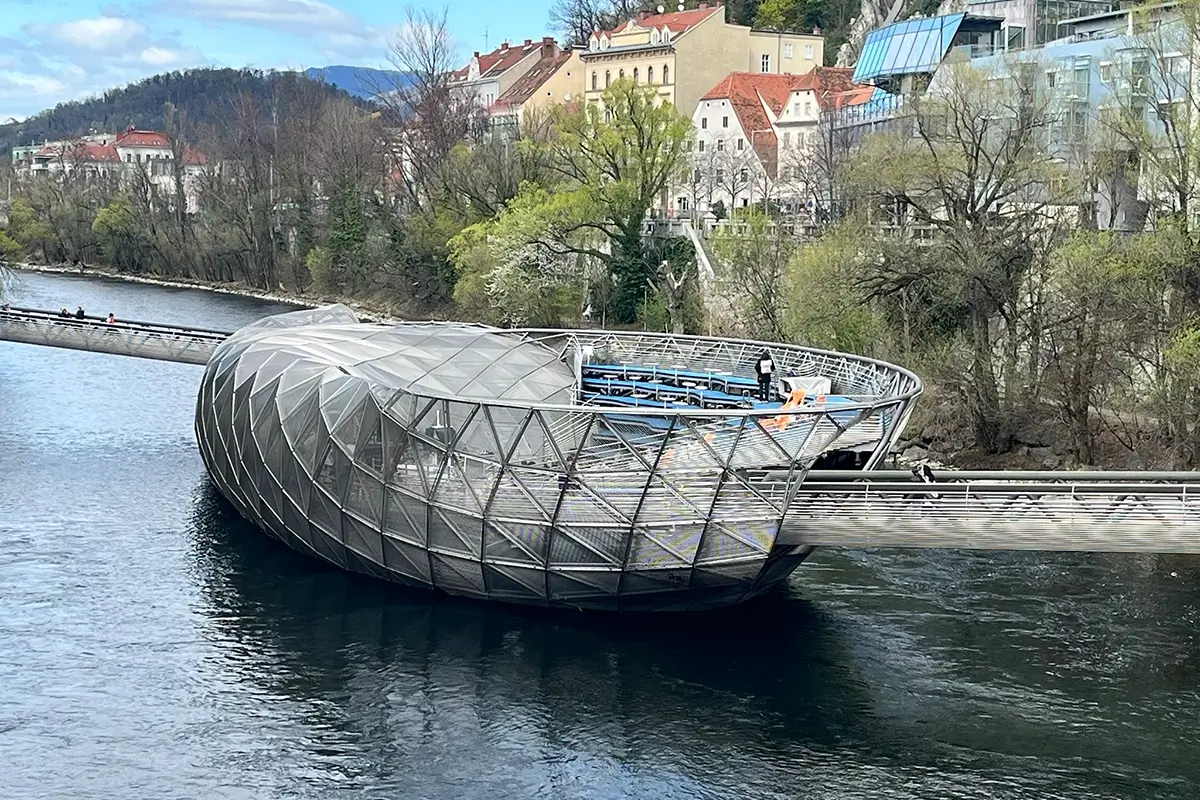
Inside, there is a café and small amphitheatre, and I found it a great place to sit in the sun and enjoy an Aperol Spritz while watching life go by.
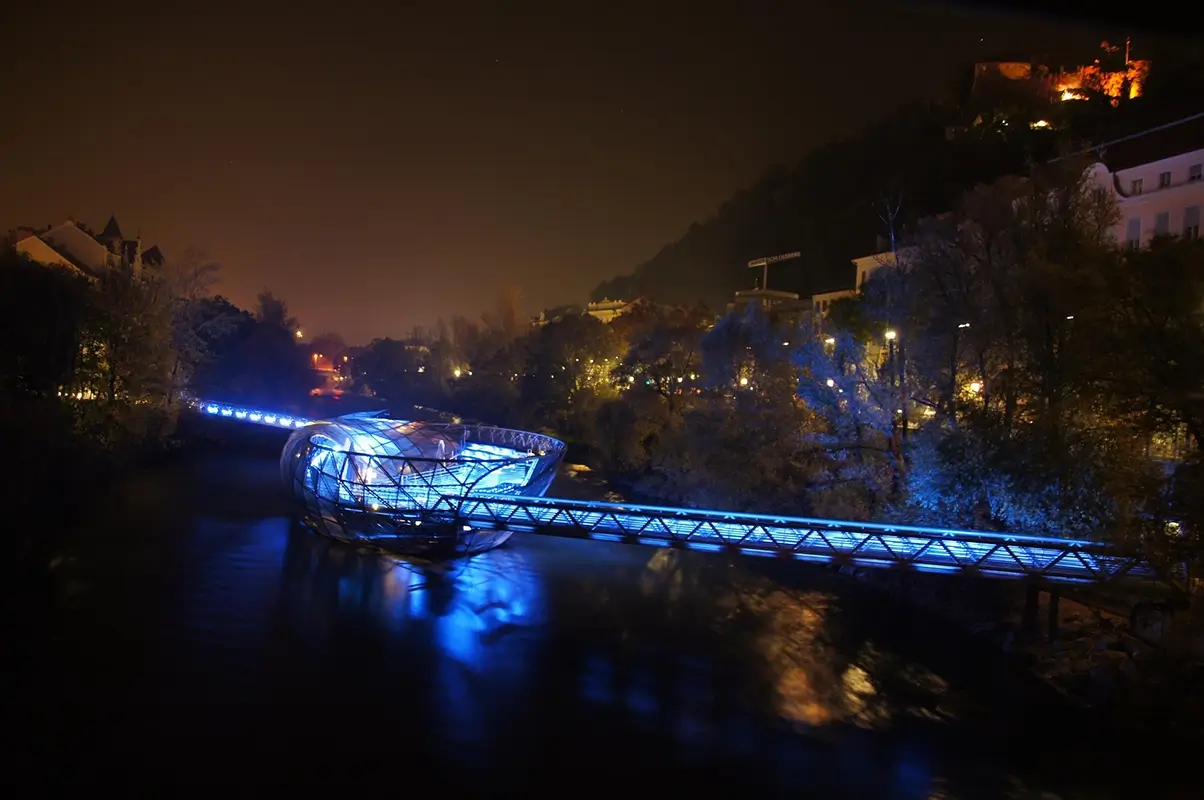
After dark, the Murinsel lights up with LED illumination, making it one of the most photogenic spots in Graz and a really striking contrast against the water.
Schloss Eggenberg: A UNESCO World Heritage Site in Graz
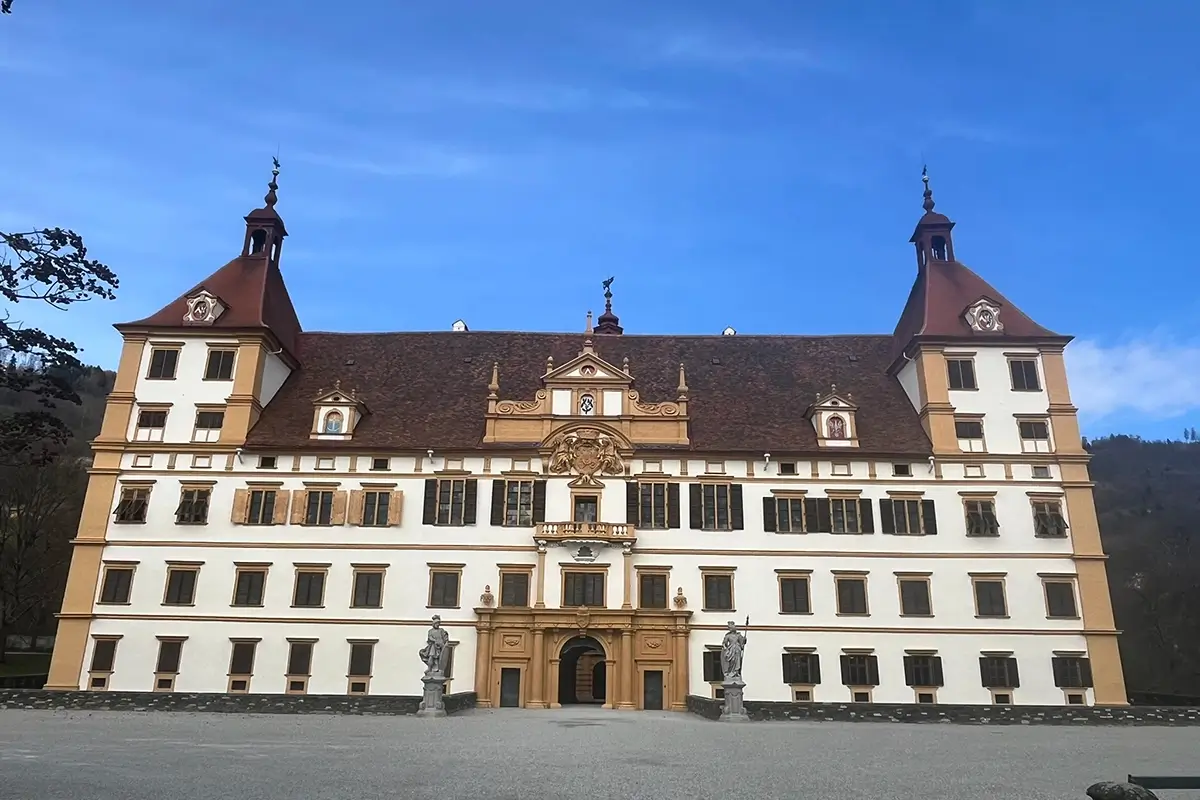
Schloss Eggenberg is a UNESCO World Heritage site and one of the most impressive things to see in Graz, featuring original Baroque, Rococo, and East Asian furnishings from the 17th and 18th centuries, along with the Alte Galerie, the Archaeology Museum, and vast landscaped gardens.
Allow at least half a day to explore the interiors, galleries, and grounds, as there is a lot to take in.
The palace was built starting in 1625 for Prince Hans Ulrich von Eggenberg, and for someone who loves history, especially Austrian history, I found the story behind it just as fascinating as the building itself.
The Eggenberg family have often been described as the “Medici of the Alps,” rising from wealthy merchants to become some of the most influential advisors to the Holy Roman Empire.
A real highlight for me was touring the State Rooms, which can only be seen on a guided tour.
These rooms, located on the Piano Nobile (noble floor), are a real time capsule.
What makes them so unique is that there is no electricity or modern heating, meaning you are seeing the rooms as they would have appeared centuries ago.
The delicate silk wall coverings, painted ceilings, and original Baroque furniture are incredibly well preserved and give a real sense of stepping back in time.
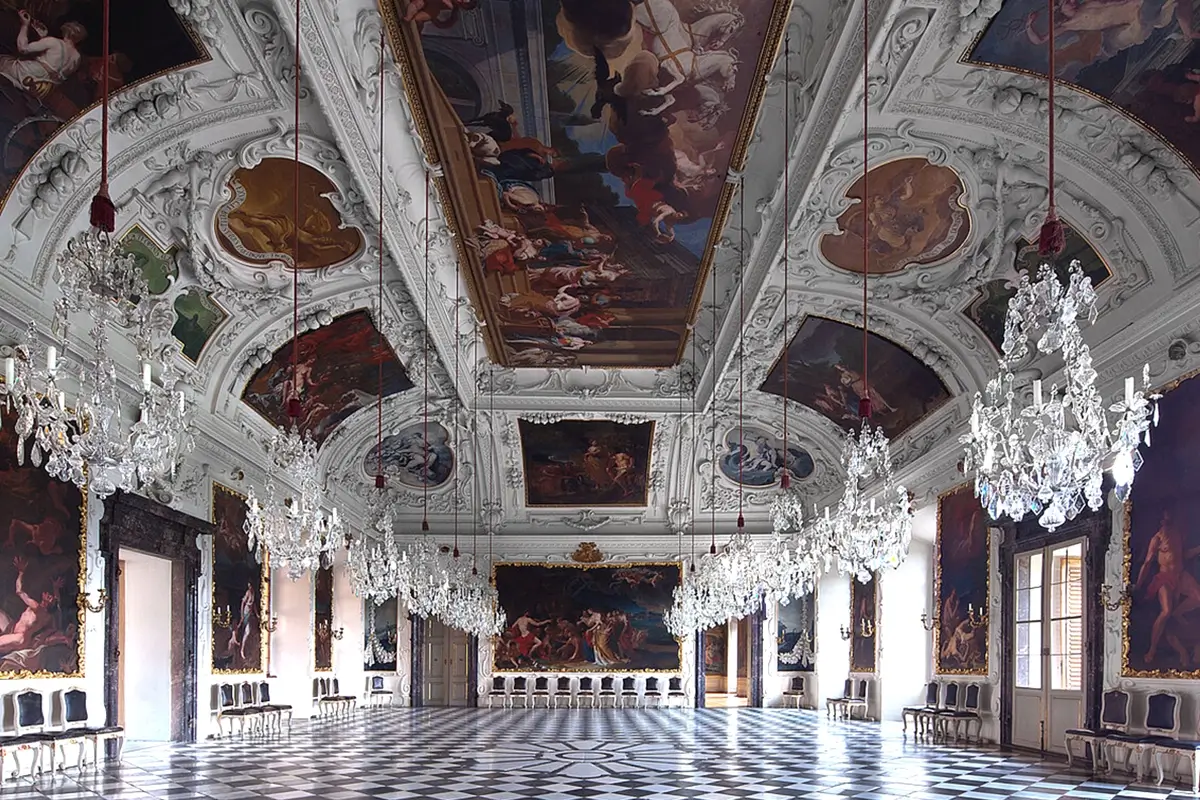
The Planetary Room of Schloss Eggenberg
Photography in the State rooms is prohibited – the image is © Museum-Joanneum -Gradischnigg
Enjoy Styrian Cuisine
Graz is often described as Austria’s culinary capital, and I quickly realised food is a big part of the experience here.
One of the first things I had to eat was a Backhendl salad, the classic Styrian fried chicken salad, dressed with pumpkin seed oil (Kürbiskernöl), which really does turn up in almost everything locally.
Graz is also well known for its wine culture.
I enjoyed trying crisp local varieties like Sauvignon Blanc and Welschriesling, best experienced in a traditional wine tavern (Buschenschank) or a relaxed wine bar.
One place I particularly liked for a casual stop was Frankowitsch, which is great for a glass of wine and a bite while people-watching.
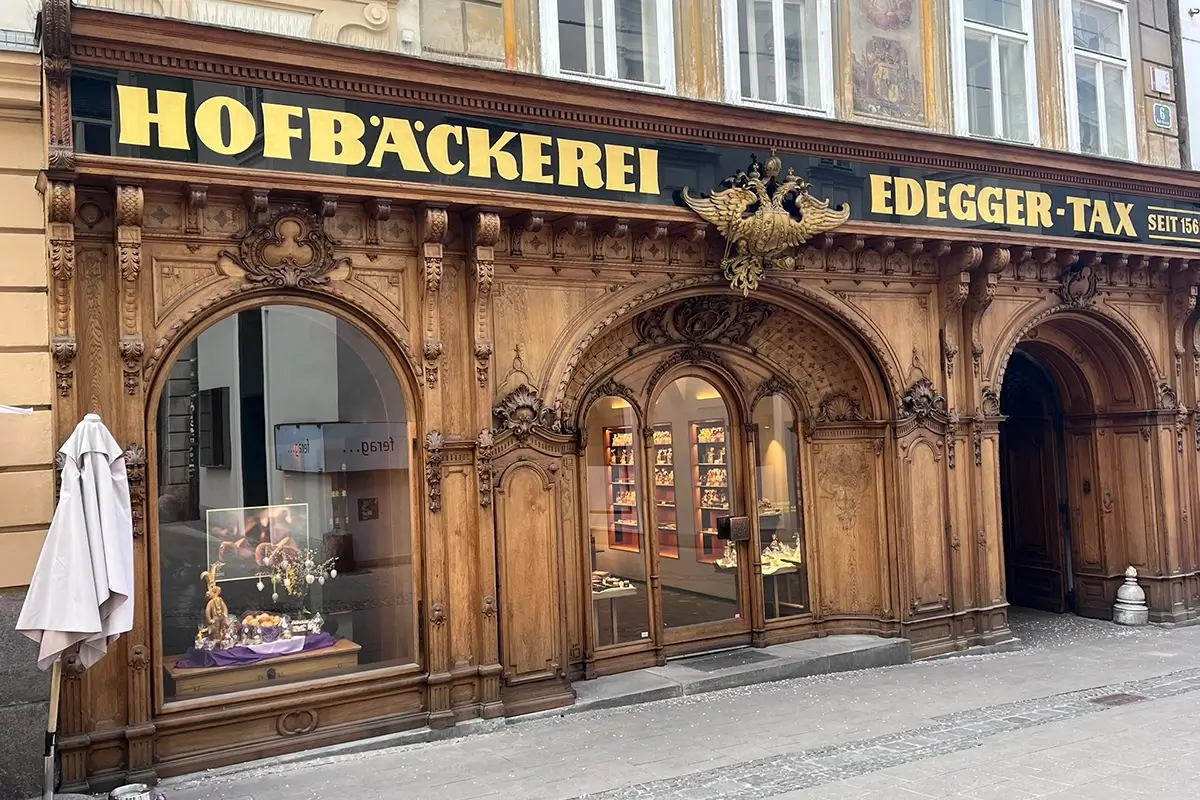
Alongside this, Graz has a strong café culture that makes it easy to slow down between sightseeing stops. I often found myself pausing for coffee breaks in traditional cafés, and stopping at bakeries like Hofbäckerei Edegger-Tax, one of the oldest in Graz and well worth a visit while exploring.

Final Thoughts
Graz really is a city that rewards slow exploration.
What I enjoyed most was how easy it was to move between historic streets, hidden courtyards, riverside paths, and viewpoints, all within a compact centre that never felt overwhelming.
Whether you are here for the architecture, the culture, or simply to wander and take it all in,
Graz has a way of staying with you long after you leave.
Graz is the kind of city that doesn’t try too hard — and that’s exactly why it’s so enjoyable. It blends history with modern creativity, all at a slower, more relaxed pace than Austria’s bigger destinations.
Give yourself a couple of days, wander often, and don’t over-plan. The best moments in Graz usually come from simply turning a corner and finding something you didn’t expect.
Continue Planning your Austria Trip
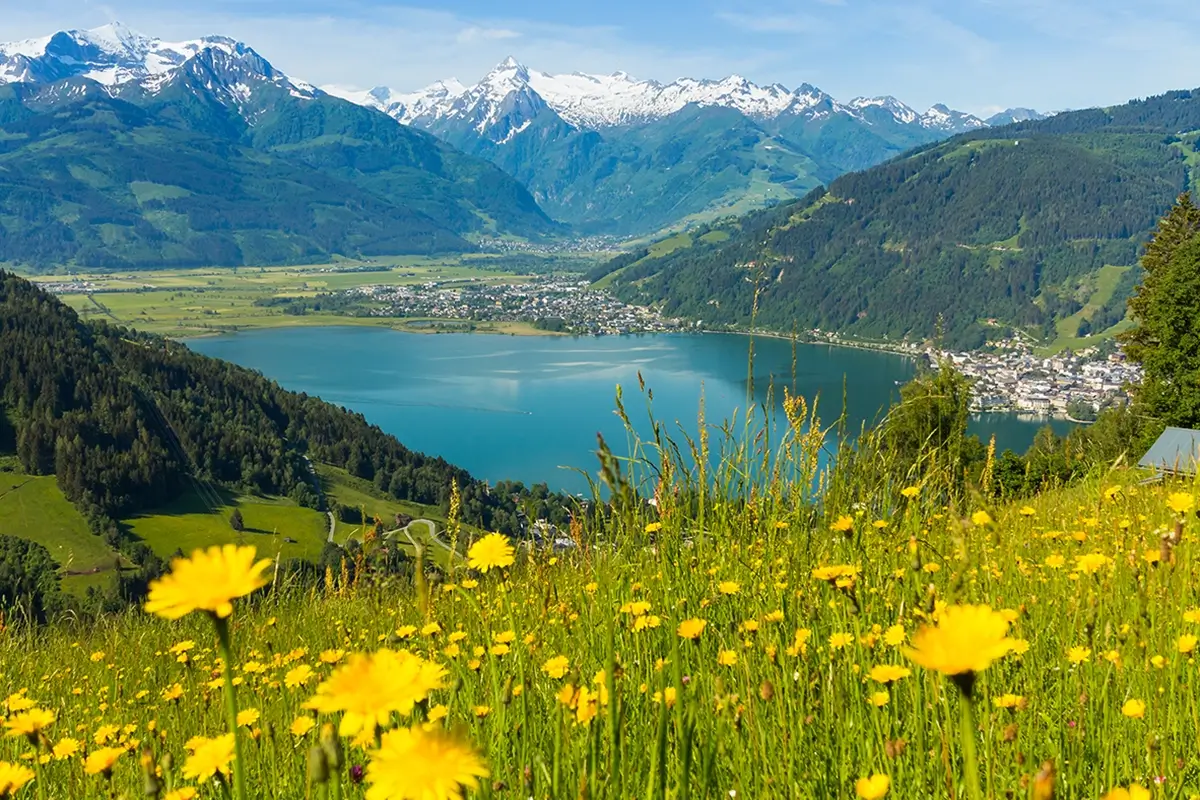
Looking beyond Graz?
Discover more of Austria’s most beautiful destinations, from historic cities and alpine villages to lakeside regions and hidden gems.
➡️ Discover Austria’s destinations and start planning your next stop

Ready to organise your trip?
Find step-by-step advice on transport, budgeting, accommodation, and travel logistics to help you plan your Austria itinerary with ease.
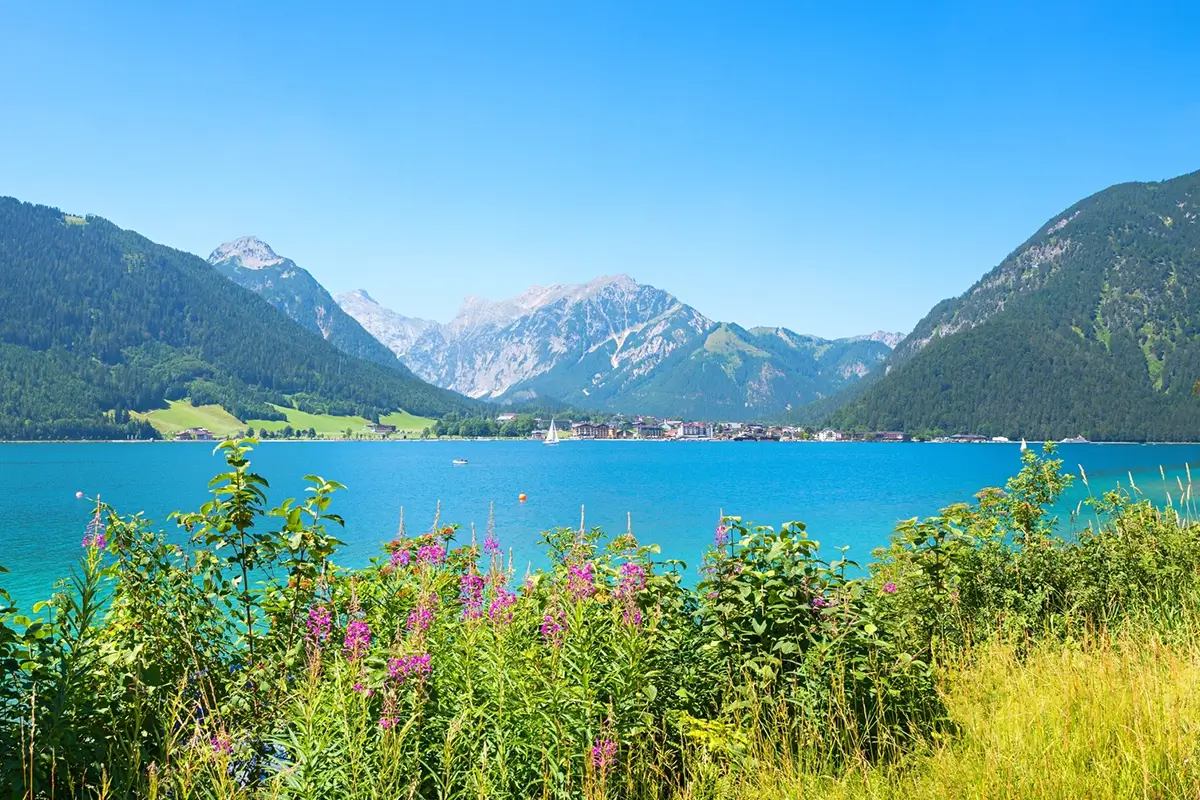
Browse seasonal travel inspiration, itinerary ideas, and unique experiences to help you discover the best of Austria.
Free 14-Days Best of Austria Itinerary
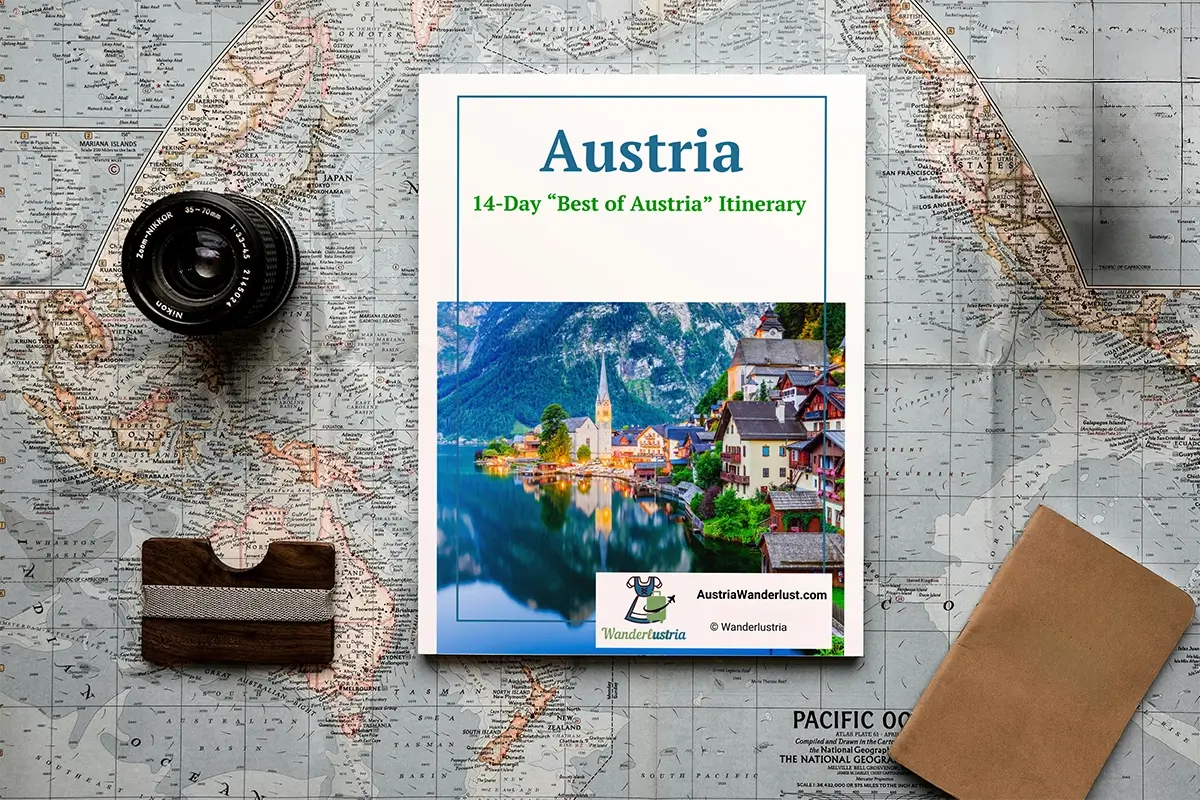
Discover the ultimate Austria adventure with this comprehensive 14-day itinerary.
From Vienna’s historic streets to alpine villages, lakes, and mountain resorts, this step-by-step guide shows you the best sights, hidden gems, and travel tips for a full two-week journey.
Perfect for first-time visitors or repeat travellers looking to explore Austria in depth.
Follow AustriaTravelPlanning by Wanderlustria

Chief Wanderlust’er and Austria travel expert, I’m on a mission to help you uncover the magic of Austria — from fairytale cities and alpine villages to awe-inspiring landscapes and rich cultural traditions.
As the founder of Austria Wanderlust Travel Planning, the Austria Travel Planning Facebook Group, and director of Wanderlustria eU, I provide trusted tips, local insights, and curated resources to make your Austrian adventure seamless, authentic, and unforgettable.